


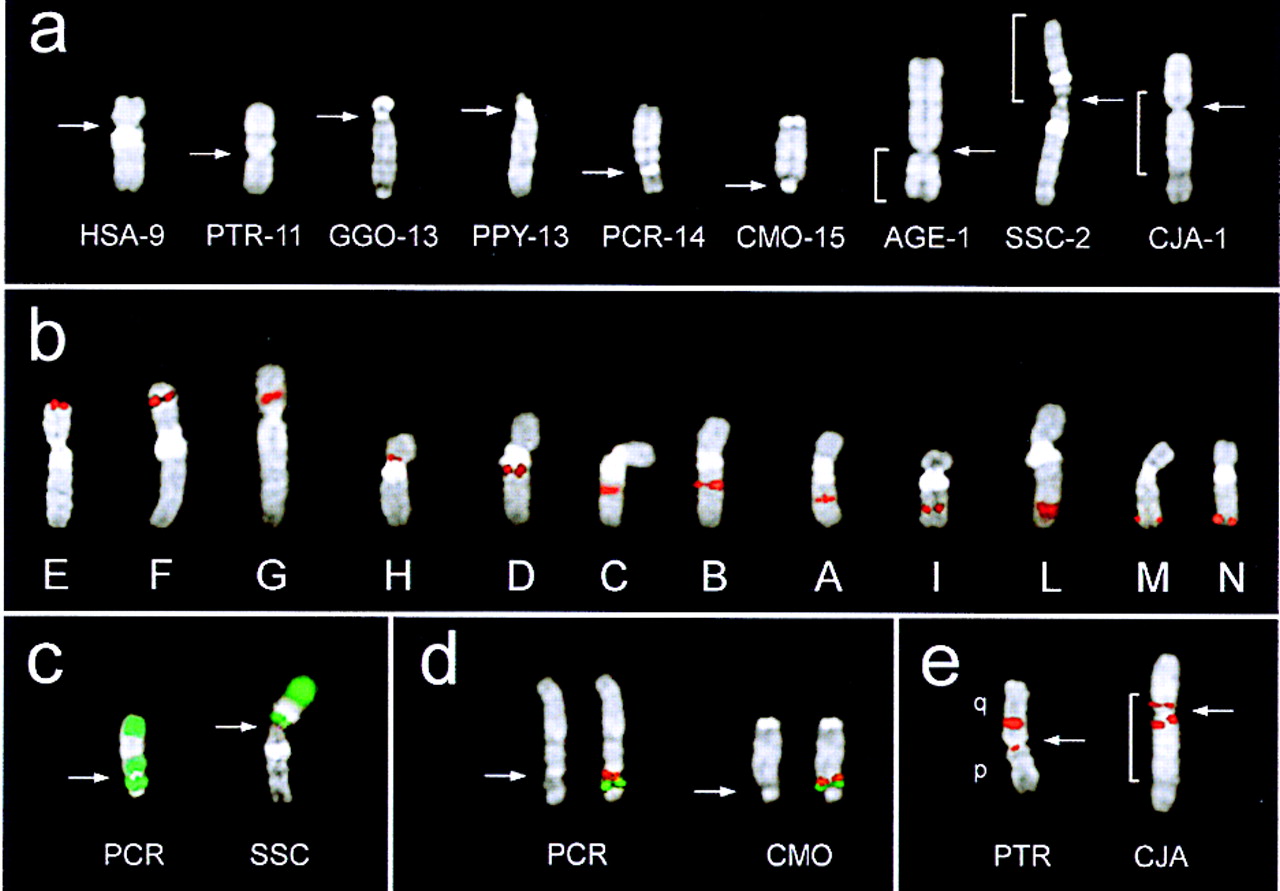
Examples of DAPI-banded phylogenetic chromosome IX from each species under study (a). Chromosome IX in AGE, SSC, and CJA is part of a larger chromosome. In all cases, however, the chromosome IX is uninterrupted. Brackets indicate the portion of chromosome IX. Some chromosomes are presented in an inverted orientation, with respect to the position of the centromere, to match the orientation reported in Fig. 2. The actual chromosome number in each species is reported on the right of the species acronym. (b) FISH signal of the 12 probes on human chromosome 9. The examples have been arranged fromleft to right in increasing mapping distance from 9pter. (c) Example of FISH signals (green) of PCP 29, specific for human 9q, on PCR (left) and SSC (right). (d) Example of a cohybridization experiment performed to establish the relative order of probes M (red) and N (green) in PCR and CMO. The DAPI-banded chromosome IX without signals is on theleft, to better show the morphology and centromere position. (e) The splitting of probe B in PTR and CJA (see text). The arrows point to the centromere.



