


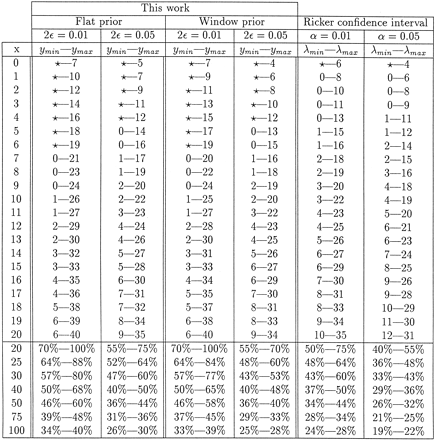
Confidence Intervals in Function of the Value ofx
|
-
The value of x (first column), one of the occurrence numbers. The intervals are given for the 95% (2 ɛ = 0.05) and 99% (2ɛ = 0.01) confidence levels. Up to x = 20, the exact boundaries, immediately outside the confidence interval (first significantly different values) are indicated. A star is used when none are possible. For larger values, the boundaries are given as percentages to be subtracted or added to x. Ricker’s confidence interval characterizes the value of λ, not y(see Methods). The use of a flat p (λ) prior distribution results in the most stringent test, as expected. Although the number (N) of clones sampled does not appear in the expression ofp(y|x) (Equation ), its influence shows in the fact that the confidence interval becomes proportionally smaller asx (and y) increases (e.g., 1 ➝ 7 has the same statistical significance as 40 ➝ 60). For the same expression level, larger N will result in larger absolute values forx and y, making the detection of significant differential expression more sensitive.



