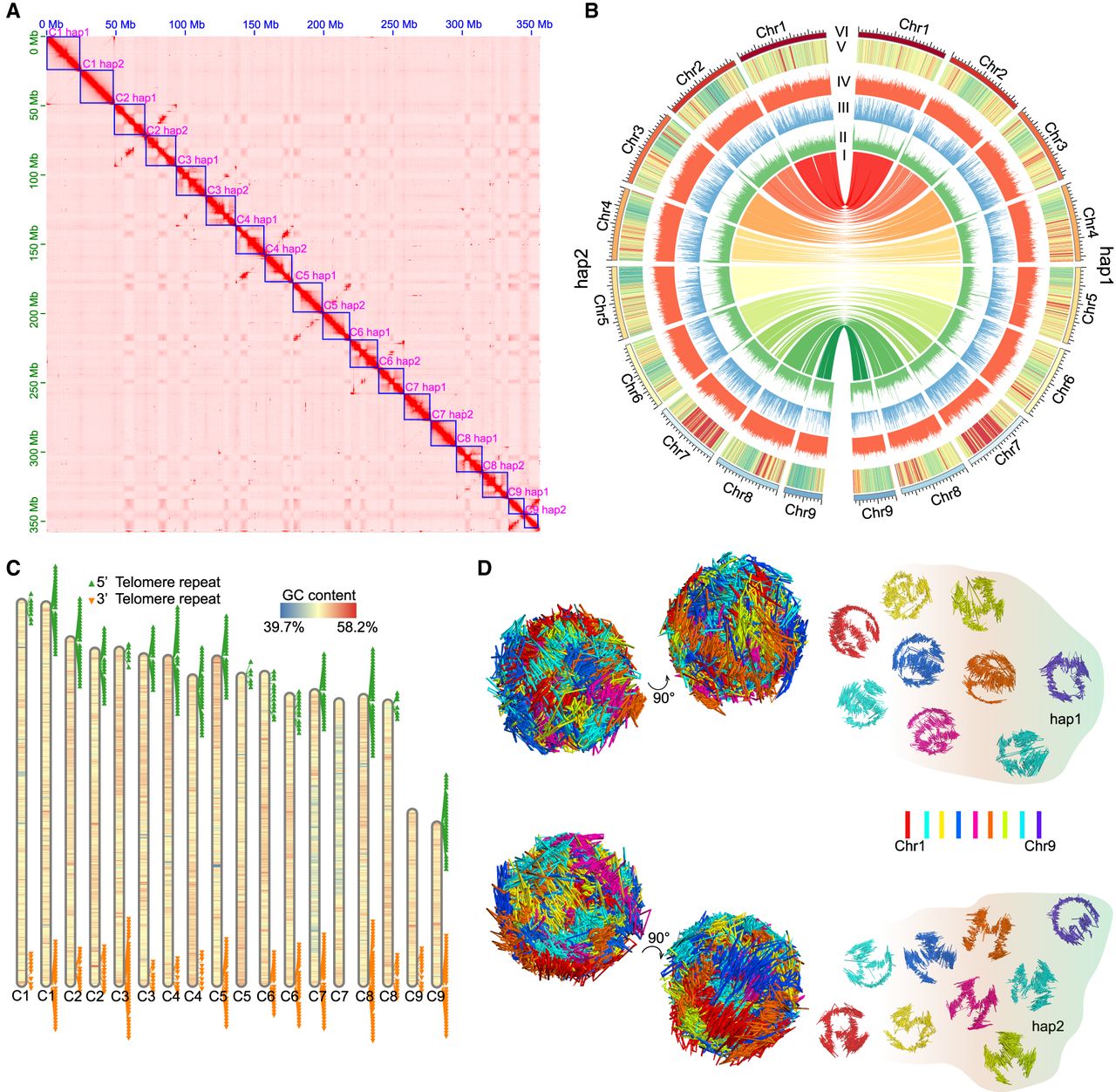
Construction of the haplotype-reserved 3D genome architecture of A. avenae. (A) Hi-C heat map of two haplotype sets of A. avenae; from top to bottom are nine pairs of homologous chromosomes 1–9. (B) Circos plot (Krzywinski et al. 2009) of A. avenae haplotype-resolved T2T genomic features. I: The collinearity between two sets of haplotypes; II: Distribution and abundance of DNA 6mA in chromosomes; III: Distribution and abundance of TE in chromosomes; IV: Distribution and abundance of GC content in chromosomes; V: Heat map of gene expression in a 50-kb window across the genome; VI: The outermost track exhibits the chromosome karyotype in units of 1 Mb. (C) The relative lengths of chromosomes and the distribution of telomeres of the two haplotypes. Each triangle represents two telomeric repeat sequences. The adjacent chromosomes are designated hap1 and hap2, respectively. (D) 3D genome structure of two haplotypes at the mix stage of A. avenae. (Left) Whole genome; (right) the nine autosome pairs visualized separately.