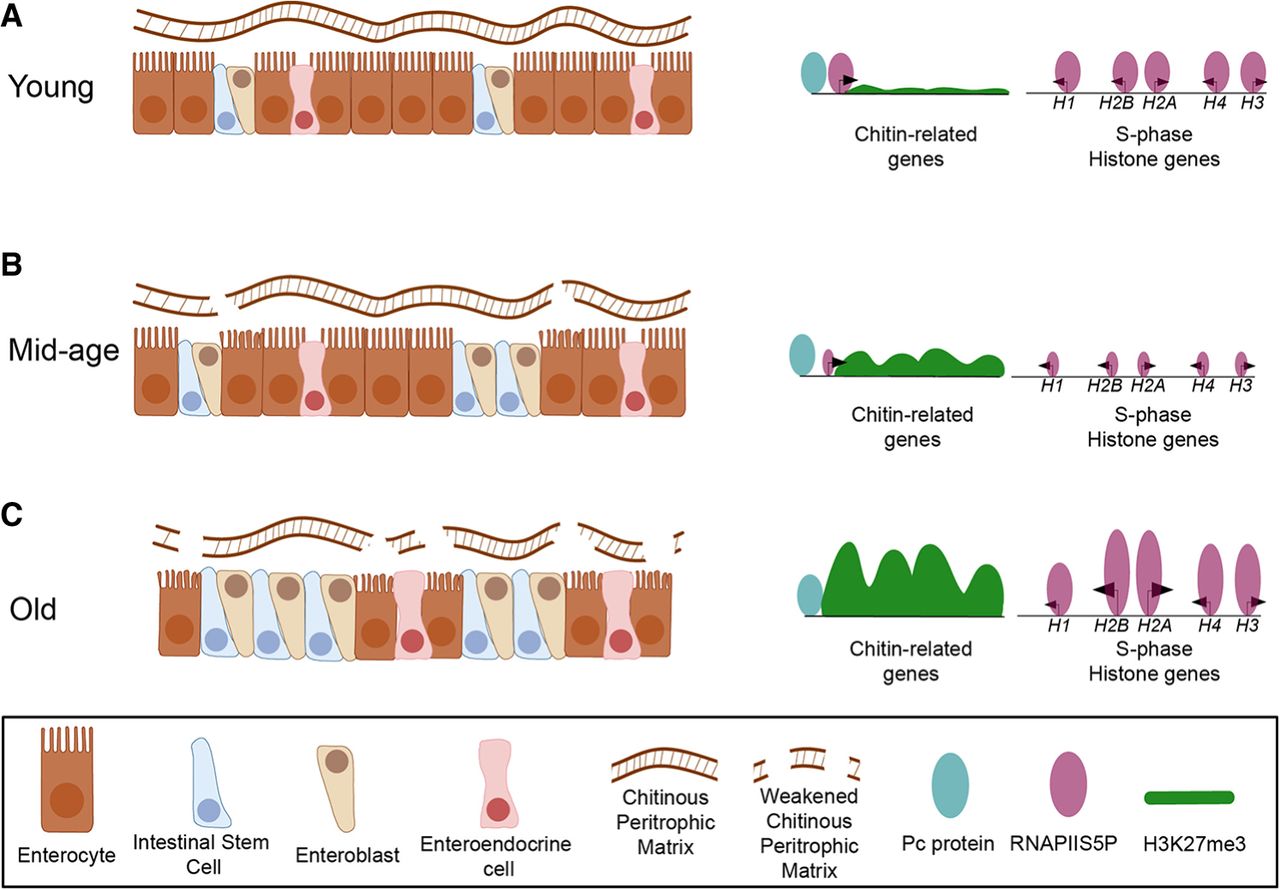
Model for cell type–specific Polycomb remodeling drives gut aging. (A) Young gut: The epithelium is composed primarily of enterocytes, with a small population of ISC/EBs. In enterocytes, Polycomb (Pc) binds chitin-related promoters (e.g., Chs2, Cht cluster), but H3K27me3 levels remain low, allowing robust RNAPII occupancy and continuous peritrophic-matrix production. Stem cells proliferate at homeostatic rates and show low RNAPII occupancy at S-phase histone loci. (B) Mid-age gut. Enterocyte numbers decline, and ISC/EBs expand. H3K27me3 signal accumulates at Pc-bound chitin genes in enterocytes, partially repressing chitin synthesis. The peritrophic matrix becomes thinned, causing moderate luminal stress and a slight increase in enterocyte turnover. Stem cells respond with increased proliferation but maintain low RNAPII at S-phase histone genes. (C) Old gut. Enterocytes are markedly depleted, and ISC/EBs predominate. In enterocytes, broad Pc-nucleated H3K27me3 domains entirely silence chitin-related loci, weakening the peritrophic matrix and exposing the epithelium to high luminal stress, further reducing enterocyte numbers. Barrier failure triggers stem cell hyperproliferation and massive RNAPII accumulation at S-phase histone loci, a histone hypertranscription signature resembling that of aggressive tumors.