


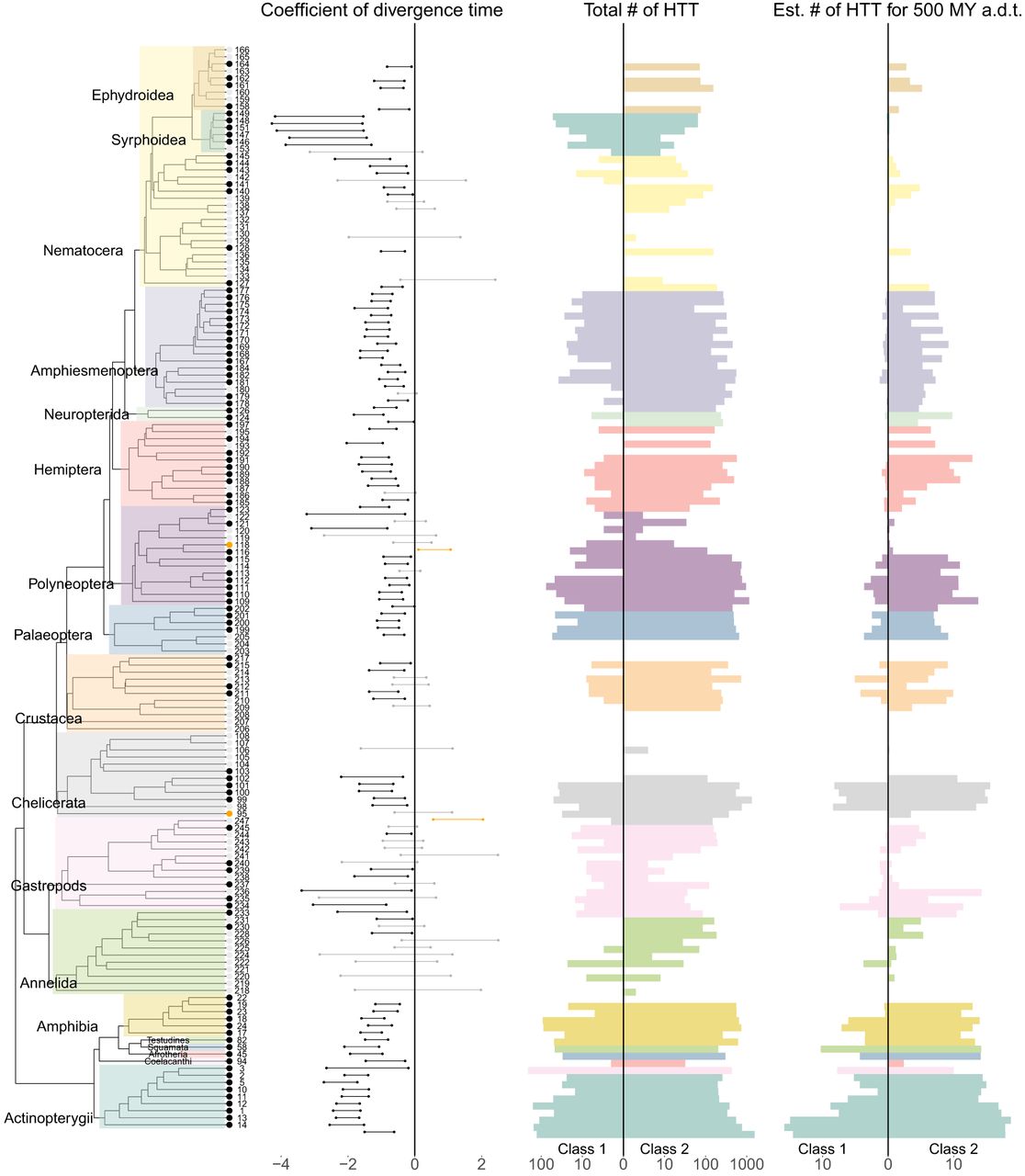
Modeling the effect of phylogenetic relatedness. The 95% highest posterior density interval (HPDI) of the effect of divergence time on horizontal transfer rate, computed for each species, is represented by a horizontal segment next to the corresponding tip of the tree (species are numbered as in Fig. 2). To save space, only one species per “species unit” was randomly chosen (see Supplemental Fig. S6 for the complete figure). Black, orange, and gray colors of segments and tree tips signify that the HPDI is below, above, or comprises zero, respectively, denoting a confidently negative, confidently positive, or nonconfident effect. Colors behind tree branches and in bar plots correspond to taxonomic groups, as in Figure 2. Absence of the HPDI segment indicates that no HTT events were observed for the species in question. The left-hand bar plot shows the observed log10 count of HTT events involving each focal species, separately for Class 1 (left-hand bars) and Class 2 (right-hand bars) TEs. The right-hand bar plot is equivalent but shows the log10 number of HTT events expected by the model when the time of divergence with the partner species is fixed at 500 My a.d.t. and a shared habitat is assumed (based on the median of the posterior distribution). Values of both bar plots can be recovered in Supplemental Dataset S6.



