


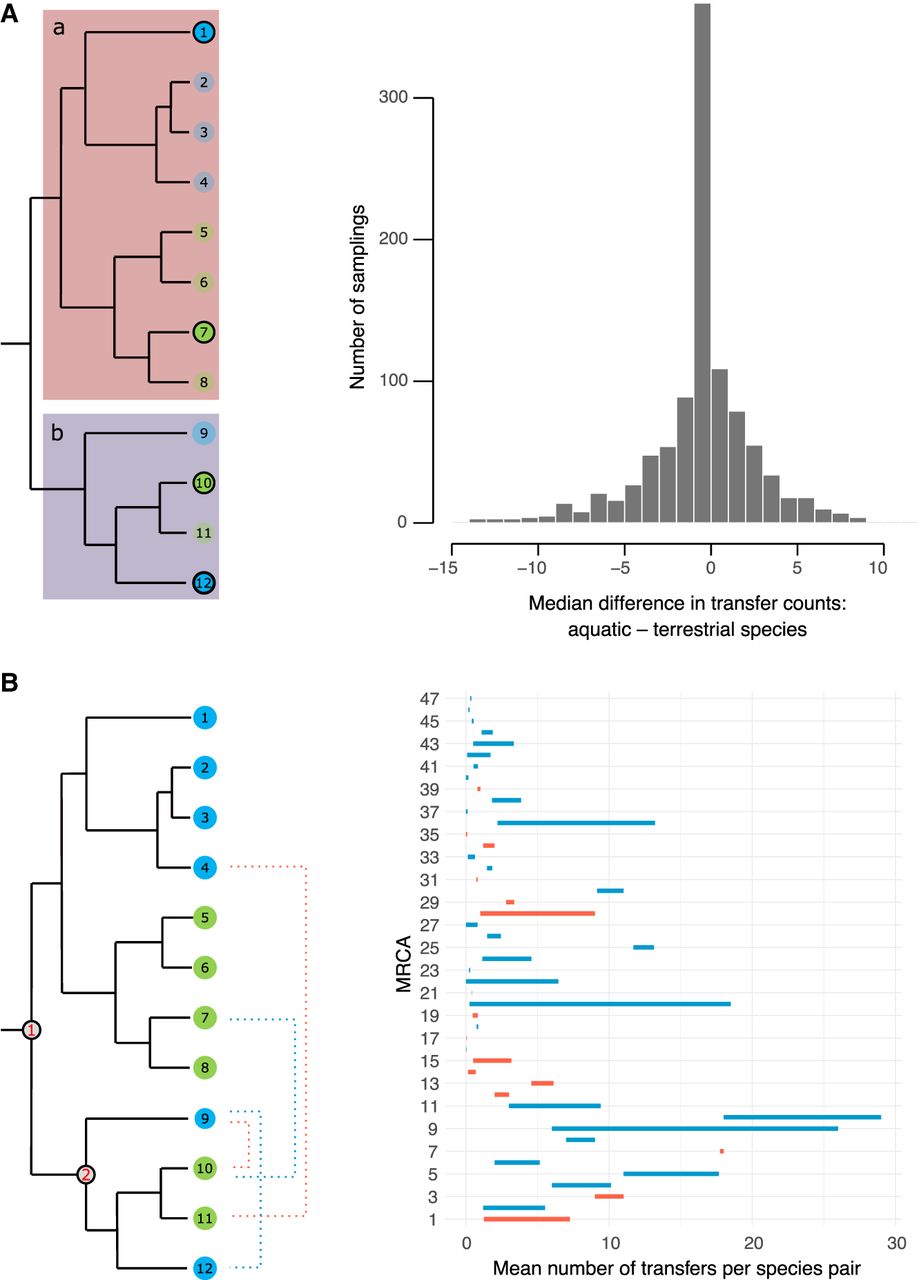
The effect of habitat on horizontal transfer of transposable elements. (Left) Principles of the approaches explained using dummy phylogenetic trees composed of 12 species belonging to two taxonomic groups (a,b). Aquatic and terrestrial species are indicated with blue and green circles, respectively. (Right) Results of analyses. (A) The effect of aquatic habitat. For each taxonomic group and habitat, one species (circled in black) is randomly sampled and its total number of HTT with the other sampled species (here, three species) is calculated. The median of the difference of HTT counts between the aquatic and the terrestrial species is then computed across all taxonomic groups. This sampling procedure was repeated 1000 times to obtain a distribution of this median (right-hand histogram). (B) The effect of habitat similarity. For species that diverged from the same common ancestor (MRCA), the mean number of HTT events for a pair of species occupying similar habitats (represented by blue dashed lines) is compared to that measured for a pair of species occupying different habitats (red dashed lines). This comparison can only be made for the MRCAs numbered in red on the tree. Segments on the right-hand plot connect both means, computed for 47 MRCAs numbered on the y-axis (see Supplemental Fig. S7 for their locations on the time tree). For clarity, only even MRCA numbers are shown. Blue and red segments denote higher means for species pairs occupying similar and different habitats, respectively.



