


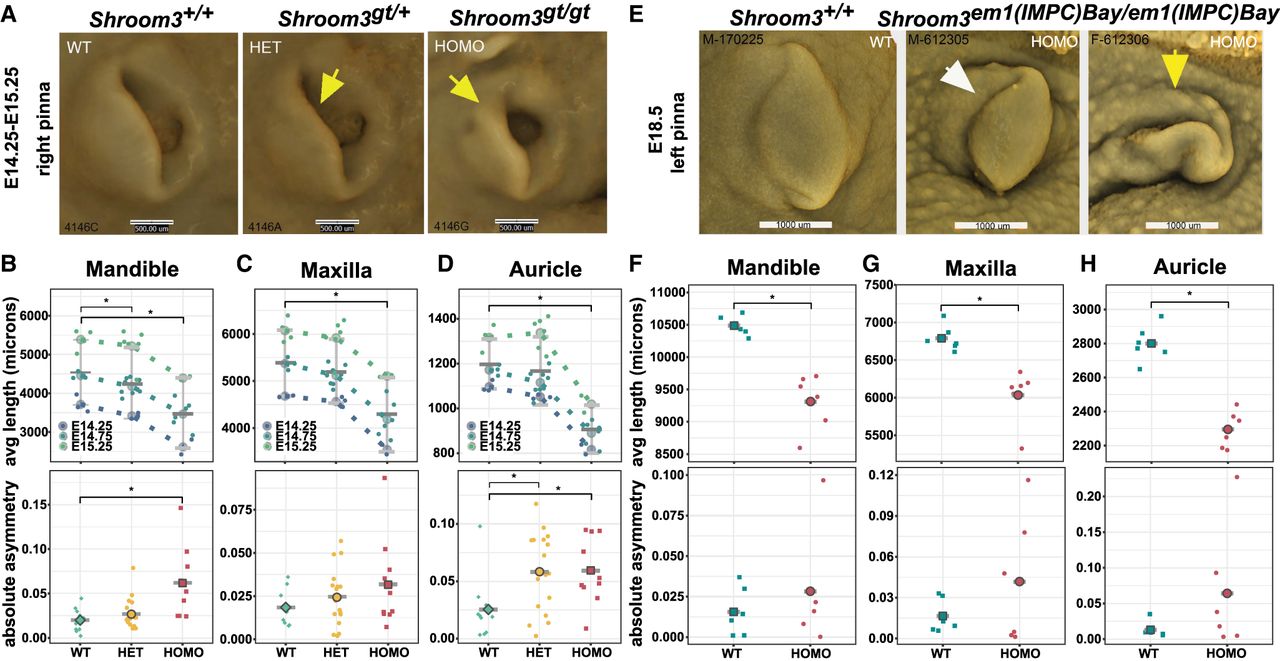
In vivo analysis of Shroom3 zygosity in mice is associated with microtia and facial asymmetry. (A) Lateral view of 3D rendered developing auricles (right side) from E14.25 wild-type (Shroom3+/+), heterozygote (Shroom3gt/+), and homozygote (Shroom3gt/gt) littermates following optical projection tomography. Note the marked microtia in the homozygote and the subtle dorsal auricular deficiency in the heterozygote (both marked by yellow arrows in the respective images) compared with the wild-type littermate. (B–D) Landmark-based quantitative assessment of auricular, mandibular and maxillary length (top) and absolute asymmetry (bottom) in wild-type, Shroom3gt/+, and Shroom3gt/gt embryos between E14.25 and E15.25. In the graphs of the average lengths of the mandible, maxilla, and auricle, dotted lines “connect” the means of the different genotypes from the same litter (stage). Mean ± SD indicated for the average length measurements; the mean (large shape with horizontal line dissecting it) is shown for the absolute asymmetry measurements. Asterisks denote statistical significance (P < 0.05). (E) Lateral view of 3D rendered auricles (left side) from an E18.5 wild type (Shroom3+/+) and two age-matched homozygote (Shroom3em1(IMPC)Bay/em1(IMPC)Bay) embryos derived from microCT scans generated by the International Mouse Phenotyping Center (IMPC; https://www.mousephenotype.org). The first homozygote (central) shows the more typical presentation of a small pinna that is inwardly curved and posteriorly rotated (white arrow). The second homozygote had significantly asymmetric pinna phenotypes - the auricular presentation of the left ear (yellow arrow) was severe, whereas the right pinna was similar in presentation to the first homozygote. (F–H) Landmark-based quantitative assessment of mandibular, maxillary, and auricular length (top) and absolute asymmetry (bottom) in E18.5 wild-type (Shroom3+/+) and Shroom3em1(IMPC)Bay/em1(IMPC)Bay null embryos. The mean (large shape with horizontal line dissecting it) is shown for each. Asterisks denote statistical significance (P < 0.05).



