


Cover image
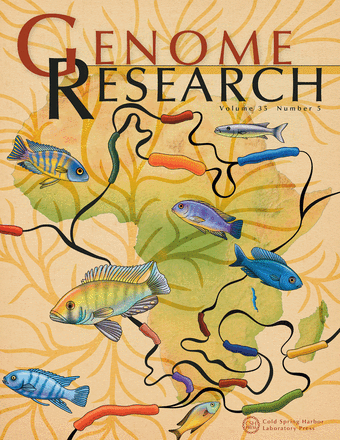
The cichlid fishes of East Africa's Rift Lakes are among the most phenotypically diverse adaptive radiations among vertebrates. In this issue, a pangenome graph is constructed from the genomes of seven representative cichlid species from Lake Malawi, uncovering 33.1% more sequence than a single cichlid genome. Structural variation between species accounts for 4.73% to 9.86% of assembly lengths, and is mostly attributable to transposable element insertions. This work highlights a level of genomic diversity that was previously underappreciated in single-nucleotide polymorphism studies of these cichlids. The cover art illustrates the concept of pangenome graphs: Sequences are represented as segments connected by lines, forming paths that highlight possible genetic variations across different genomic regions. Astatotilapia calliptera, thought to most closely resemble the putative ancestral state of the Lake Malawi radiation, takes center stage, with phylogenetic trees branching from it. Other studied species are perched on these branches, all set against the backdrop of the African continent featuring the outline of Lake Malawi. (Cover art by Sonhita Chakraborty, www.artbysonhita.com, based on a concept by Fu Xiang Quah and feedback from Miguel Vasconcelos Almeida. [For details, see Quah et al., pp. 1094–1107.])

