


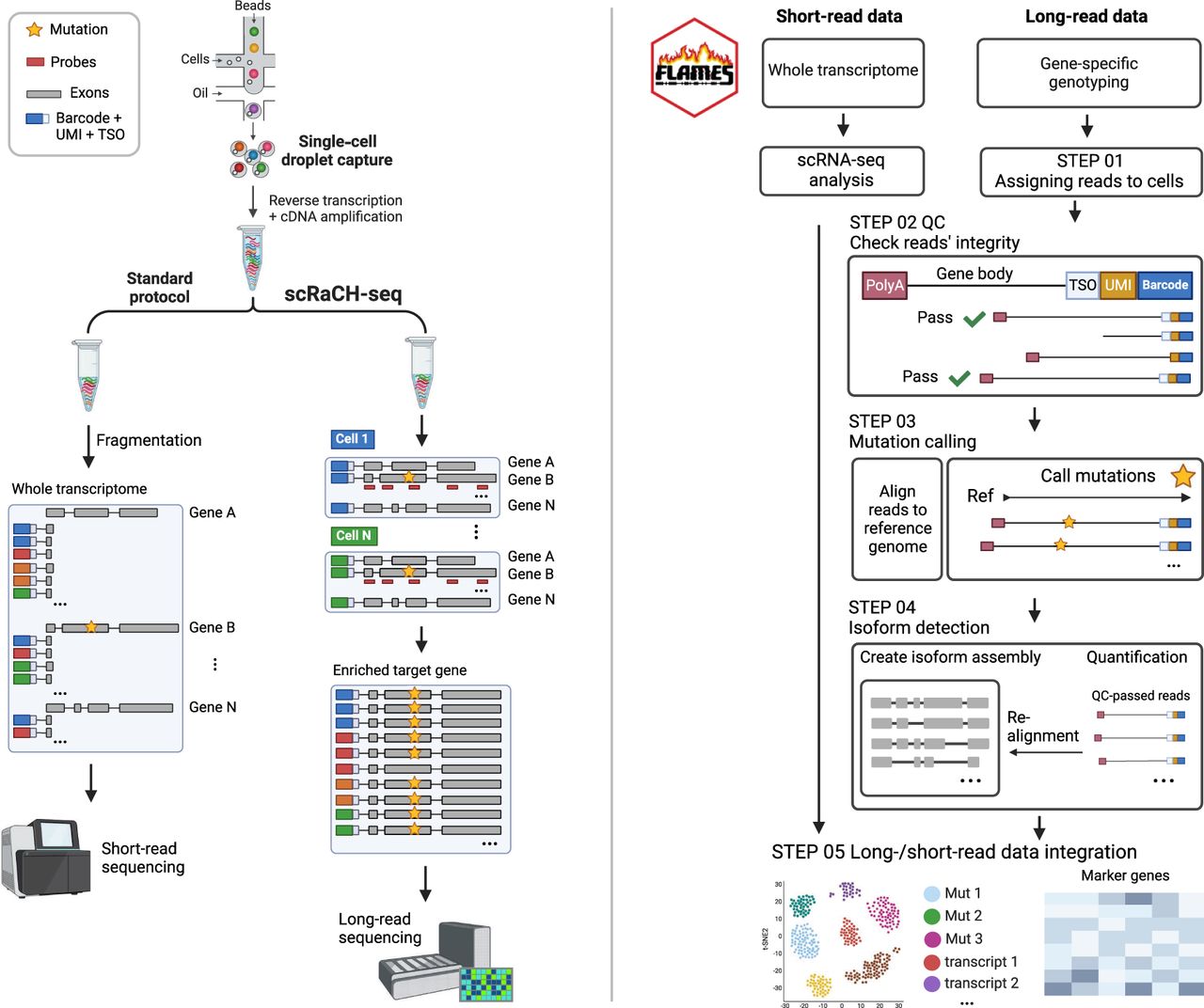
Schematic of scRaCH-seq approach and FLAMES pipeline for single-cell long-read data analysis. scRaCH-seq can be incorporated in the standard high-throughput single-cell RNA-seq experiments (left side). After single-cell isolation, mRNA is converted into cDNA and barcoded. Only some of this amplified indexed cDNA is used for short-read library preparation and Illumina sequencing. The surplus cDNA is stored and can be used for scRaCH-seq. For scRaCH-seq, a probe panel is designed for genes of interest. The biotinylated probes are hybridized with amplified cDNA overnight. The probes and target genes are captured with Streptavidin beads, washed, and amplified. The enriched target long-read transcripts are sequenced on the Nanopore platform. With the FLAMES pipeline, FASTQ files are demultiplexed by cross-referencing the cell barcodes identified in scRNA-seq data (STEP 01). Next, the demultiplexed reads undergo an integrity check and the reads that possess a UMI, a TSO sequence, and poly(A) tails are retained (STEP 02). Reads are aligned to the GRCh38 reference genome to construct a transcript assembly. Concurrently, the piled-up reads are compared against GRCh38 to identify base alterations and deletions, generating a comprehensive mutation/deletion matrix (STEP 03). The reads are realigned to the transcript assembly for quantification (STEP 04). Single-cell short-read gene expression data is used to cluster the cells, based on the conventional analysis pipeline for scRNA-seq. The transcript usage and mutation/deletion information are then aligned with the single-cell gene expression data. The bridge connecting these data sets is the shared cell barcodes, ensuring the gene expression profile at a transcript level (STEP 05).



