


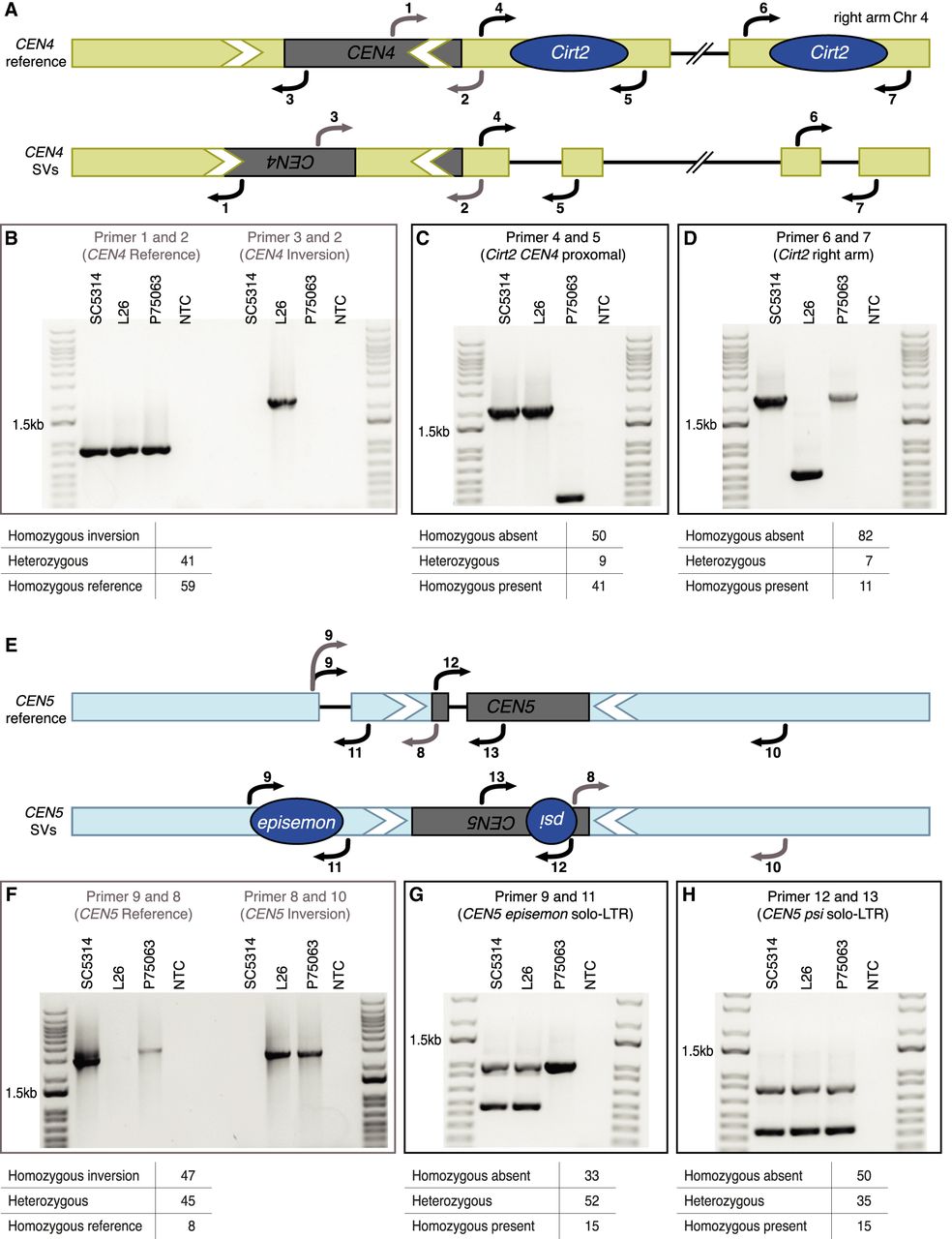
Confirmation of centromere inversions and TE polymorphisms. Diagnostic PCR of CEN4 and CEN5 and representative strains. The table below each EtBr-stained DNA gel indicates the PCR results from 100 compiled clinical isolates. A full visualization of the 100 clinical isolates is available in Supplemental Figure S7. (A) Schematic of the primers for CEN4. Cse4p/CENPA binding delineates the central core sequence of the centromere and is indicated with a gray box (Sanyal et al. 2004; Ketel et al. 2009). (B) CEN4 inversion is indicated by primer pair 1 and 2 for a reference orientation, and primer pair 3 and 2 for an inversion. (C) CEN4 pericentromeric Cirt2 (orf19.3820) presence is indicated by the primer pair 4 and 5. (D) Right arm Chr 4 Cirt2 (orf19.2866) presence is indicated by the primer pair 6 and 7. (E) Schematic of the primers for CEN5. (F) CEN5 inversion is indicated by primer pair 9 and 8 for a reference orientation, and primer pair 8 and 10 for an inversion. (G) CEN5 solo-LTR episemon presence is indicated by the primer pair 9 and 11. (H) CEN5 solo-LTR psi presence is indicated by primer pair 12 and 13. All primers are described in Supplemental Table S3.



