


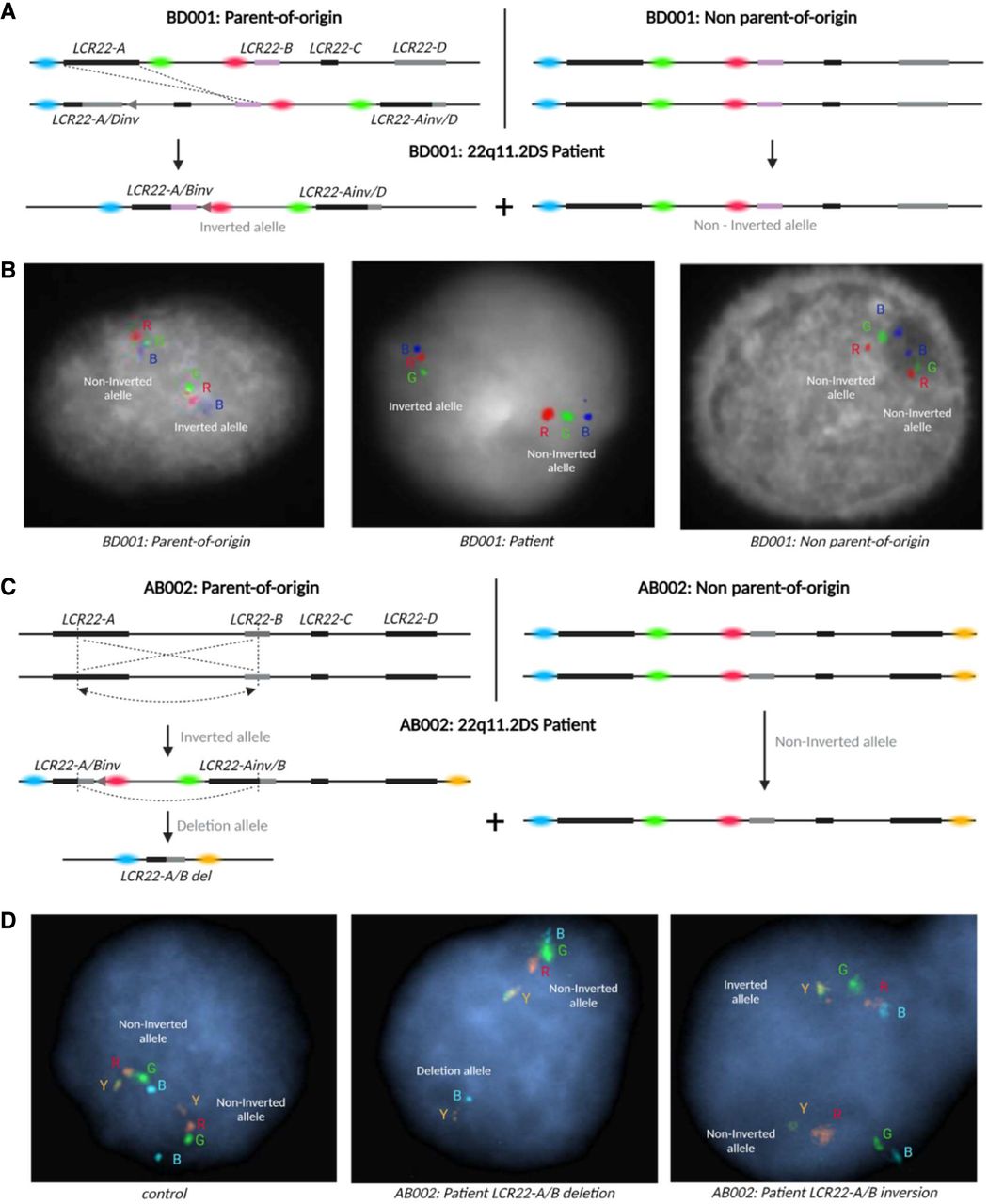
Inversion-associated rearrangements. (A) Schematic representation of the rearrangement of family BD001: the parent-of-origin (left) carries an LCR22-A/D inversion, which is recombined between LCR22-A and -B (dotted line) causing the presence of a deletion allele in the patient, missing the sequence from LCR22-B until -D. In addition, the patient inherited one of the wild-type alleles of the other parent (right). Colored dots represent the probes used in the interphase-FISH. (B) Interphase-FISH results using color-labeled probes CH17-320A22 (proximal LCR22-A, blue, B), CH17-222C16 (distal LCR22-A, green, G), and CH17-389E17 (proximal LCR22-B, red, R) in the parent-of-origin (left), patient BD001 (middle), and the other parent (right). (C) Schematic representation of the rearrangement of family AB002: both parents carry two normal LCR22 haplotypes (LCR22-A until -D). The patient carries a wild-type allele (right) and an LCR22-A/B inversion allele is observed (inverted gray arrow), created by the recombination (dotted line and arrow) of the LCR22-A and -B allele from the parent-of-origin. We hypothesize the deletion is created in a consecutive manner by a new recombination between these blocks. Colored dots represent the probes used in the interphase-FISH. (D) Interphase-FISH results using color-labeled probes CH17-320A22 (proximal LCR22-A, blue, B), CH17-222C16 (distal LCR22-A, green, G), CH17-389E17 (proximal LCR22-B, red, R), and RP11-354K13 (distal LCR22-D, yellow, Y) in a control individual (left), deletion-carrying cell of patient AB002 (middle), and inversion-carrying cell of patient AB002 (right).



