


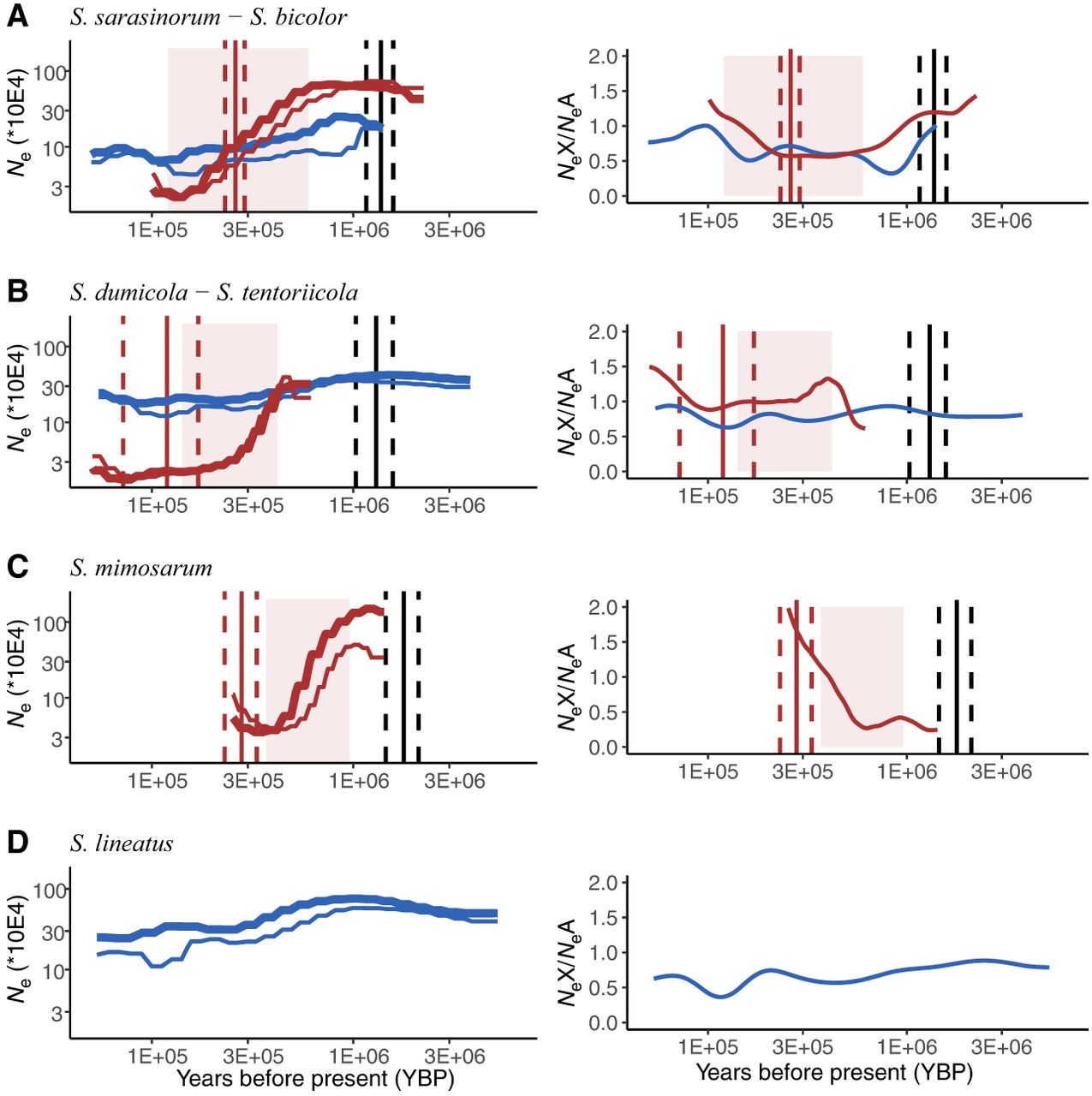
The historical effective population size inferred from the pairwise sequentially Markovian coalescent (PSMC) model, for different Stegodyphus species with chromosome-level assembly. In each panel, the left figure depicts PSMC results, and the right figure displays the effective population size ratio between X Chromosomes and autosomes. Each species’ trajectory is shown with thicker lines for autosomes and thinner lines for X Chromosomes. The types of species are distinguished by color: red for social species and blue for subsocial species. Red shadows mark the estimated social transition period based on the decreasing effective population size in social species. Vertical lines indicate estimated time points by comparing the social species with its closest sister subsocial counterpart. Red vertical lines correspond to the estimated social transition time, derived from relaxed selection in social species, and black vertical lines represent the estimated divergence time between a social species and its closest subsocial sister species. Solid lines provide point estimates, and dashed lines delineate the 95% confidence intervals. The PSMC results are truncated in the near recent past for better comparison across species. Bootstrapped PSMC results without time truncation are provided in Supplemental Figure S9. (A) Data for the social species S. sarasinorum and the subsocial species S. bicolor. Estimates for social transition and divergence time are based on a comparison between S. sarasinorum and its subsocial sister species, S. pacificus. (B) Findings from a comparison between the social species S. dumicola and its subsocial sister species S. tentoriicola. (C) Data for the social species S. mimosarum, with social transition and divergence time estimates based on a comparison with its subsocial sister species, S. africanus. Note that we do not have an effective population size estimation for S. africanus owing to missing whole-genome data. (D) Historical effective population size for the outgroup subsocial species S. lineatus.


