


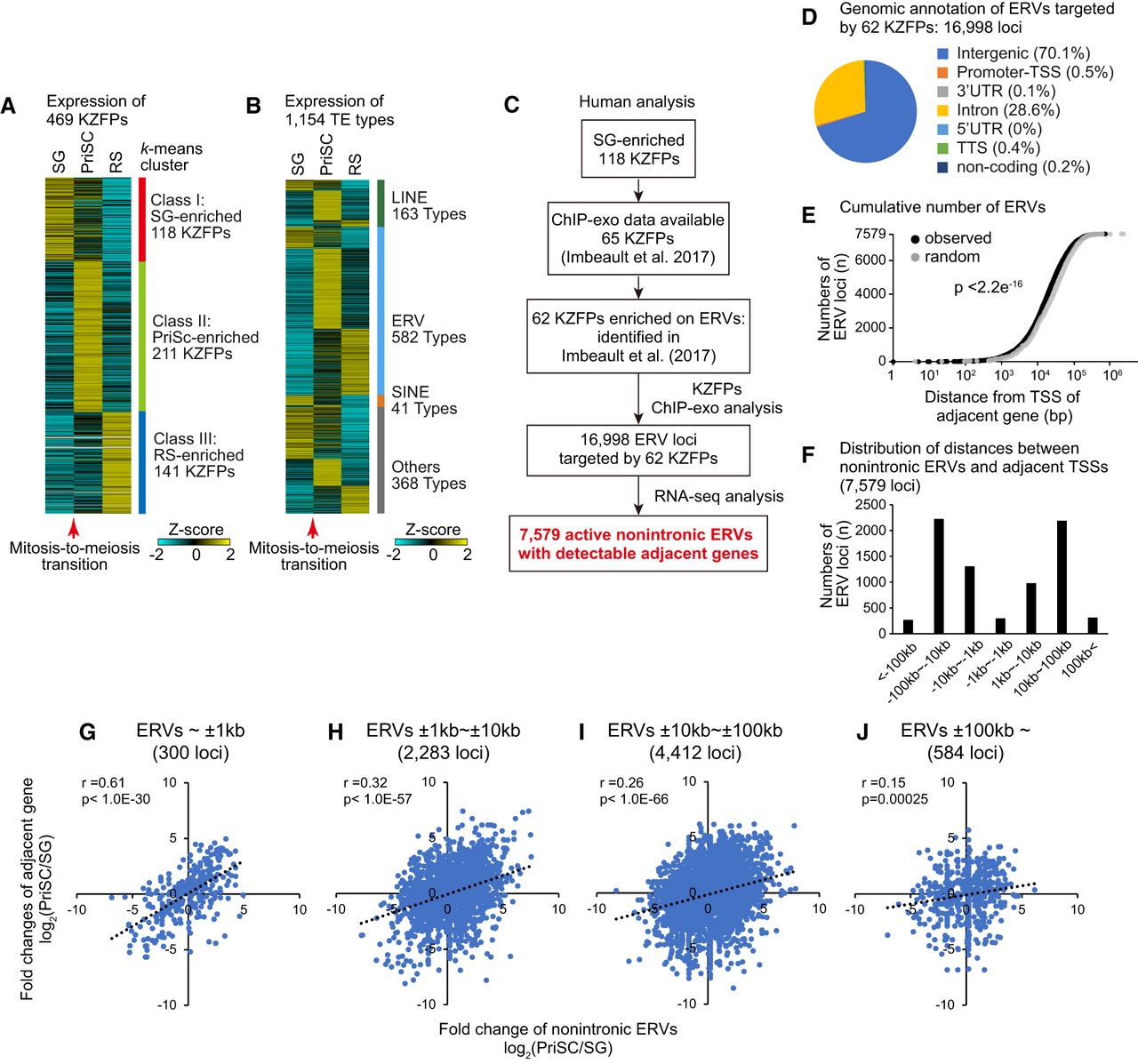
Human premeiotic KZFPs can act as suppressors of meiotic enhancer ERVs. (A) Heatmaps showing a k-means clustering analysis of expression (RNA-seq data) for all protein-coding KZFPs in human testicular germ cells. (B) Heatmaps showing the expression (RNA-seq data) of all detected TE types in human testicular germ cells. (C) Flowchart of analyses to identify target ERVs. (D) Genome annotation of the human ERV loci targeted by 62 human SG-enriched KZFPs. (E) Cumulative curve of active nonintronic ERVs targeted by 62 human SG-enriched KZFPs, based on the distance to the most adjacent TSSs. The gray dots represent the distance from randomly chosen ERVs to the most adjacent TSSs. D and P-value are calculated by the Kolmogorov–Smirnov test. (F) Distances between ERVs targeted by 62 human SG-enriched KZFPs and their adjacent genes. (G–J) Correlation between expression of the adjacent gene and nonintronic ERVs at the mitosis-to-meiosis transition (PriSC/SG). All nonintronic ERVs were separated into four groups according to the distance to the most adjacent genes. The correlation coefficient (r) and P-value are shown.


