


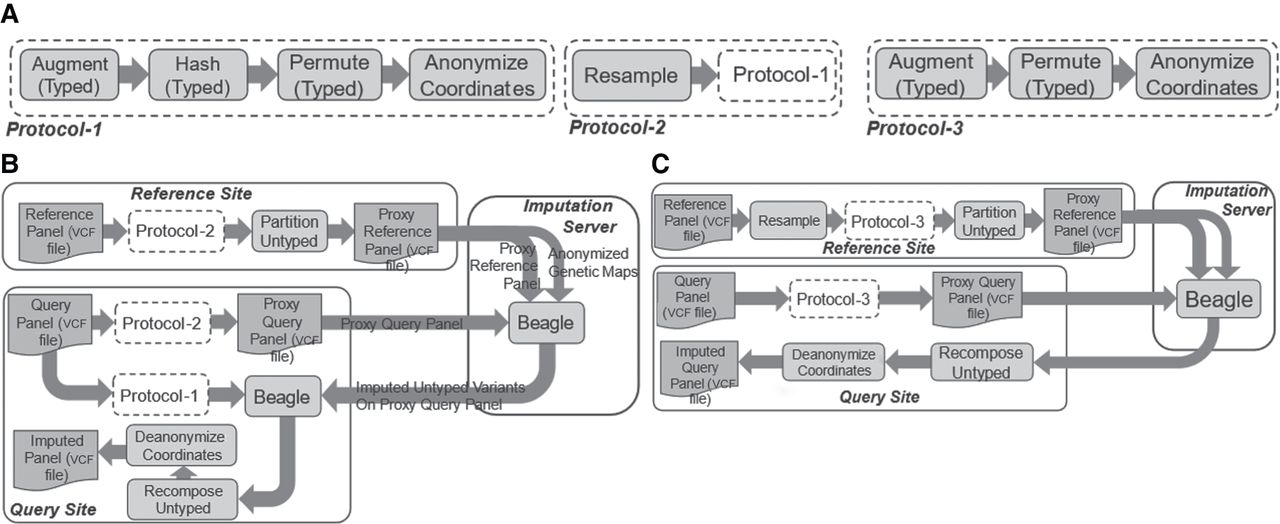
Illustration of phased- and unphased-query protocols using the mechanisms as building blocks that map and mutate panels. (A) Protocol-1 is a subblock to process typed variants in phased panel protocols. It starts by augmenting the typed variants, hashing the alleles, permuting the variants, and finally anonymizing coordinates. Protocol-2 prepends resampling mechanism to Protocol-1. Protocol-3 is similar to Protocol-1 but does not include a hashing step. Protocol-3 is a subblock used in unphased-query protocol. (B) Phased-query protocol. The reference site processes its panel with Protocol-2. Then it protects the untyped variants by the “partition untyped” mechanism. The query also processes its panel with Protocol-2. Both sites send the proxy panels to the imputation server, which runs Beagle and sends the results to query site. Note that imputation server also receives the anonymized genetic maps from the reference site. After receiving the imputed panel from the server, the query site first processes its panel with Protocol-1 (no resampling) and performs local reimputation using this panel as the input to Beagle. After reimputation, the query recomposes untyped variants and deanonymizes coordinates. The final result is a VCF file with imputed variant genotypes. (C) Unphased-query protocol. The reference panel first resamples and processes its panel with Protocol-3. It finally partitions untyped variants. The query site processes its panel with Protocol-3. Both sites send the proxy panels to the imputation server. After running Beagle, the server returns results to the query site, which recomposes the untyped variants and deanonymizes coordinates.


