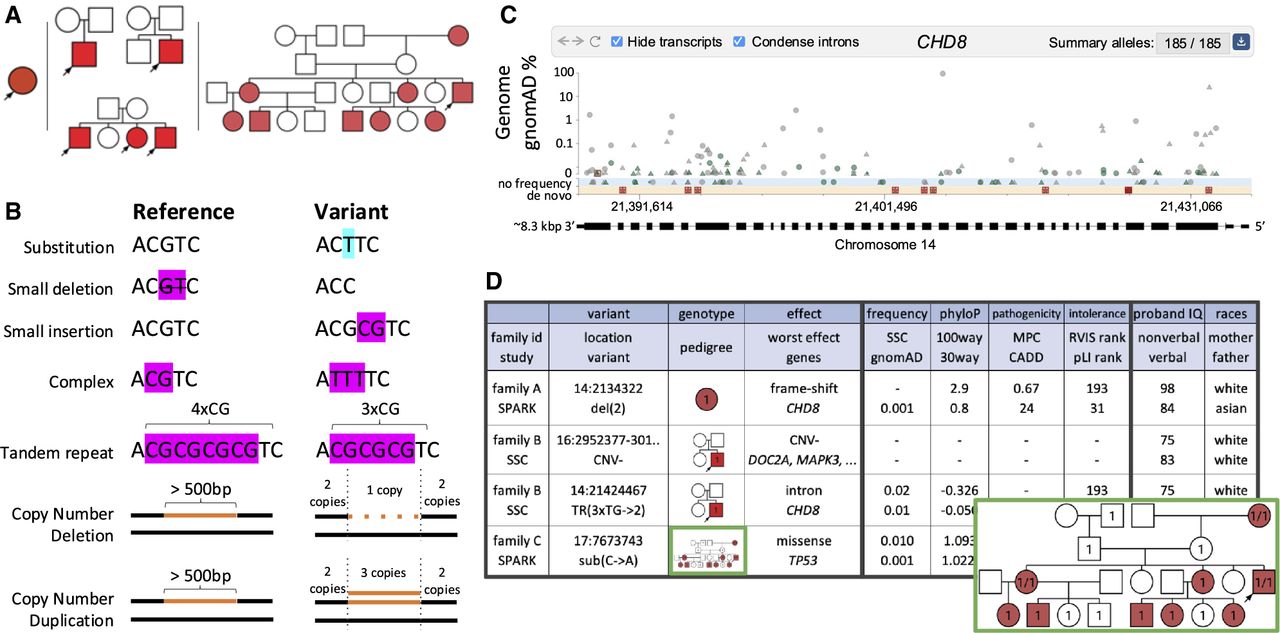
General features of GPF. (A) GPF supports various family structures represented as pedigree diagrams, in which parent–child relationships are shown with lines; males and females with squares and circles, respectively; and phenotypes with colors. In this panel, red indicates individuals with autism, and white indicates those without. Shown are a family with a single individual (left), three nuclear families (two parents and their children; middle), and a complex multigenerational family (right). Arrows indicate the probands. (B) GPF supports various genetic variant types represented relative to a reference genome, including substitutions, short insertions and deletions, copy-number variants, and tandem repeats (or microsatellites). (C) The gene view component shows the population (or summary) variants in a gene of interest. The gene view represents the genomic location of the variants on the x-axis in the context of the gene isoforms and the variant frequencies on the y-axis. Stars, triangles, and circles are likely-gene disruption (LGD), missense, and synonymous variants, respectively. Red squares indicate de novo variants. (D) The family variants view, organized into three sections, displays variants that segregate within families. The first section shows the family (the family ID/study column), the variant (the location/variant column), the segregation pattern (the pedigree column), and the variant's predicted effect on the protein-coding genes (the worst effect/genes column). In the segregation patterns, numbers indicate the alternative alleles segregating in the family. For example, an individual with “1” is heterozygous with a first alternative allele and a reference allele, and an individual with “1/1” is homozygous with two alternative alleles. The second section shows the GPF's extensive genomic annotations assigned to each variant. The third section shows relevant phenotypic measures of the probands or their family members.