


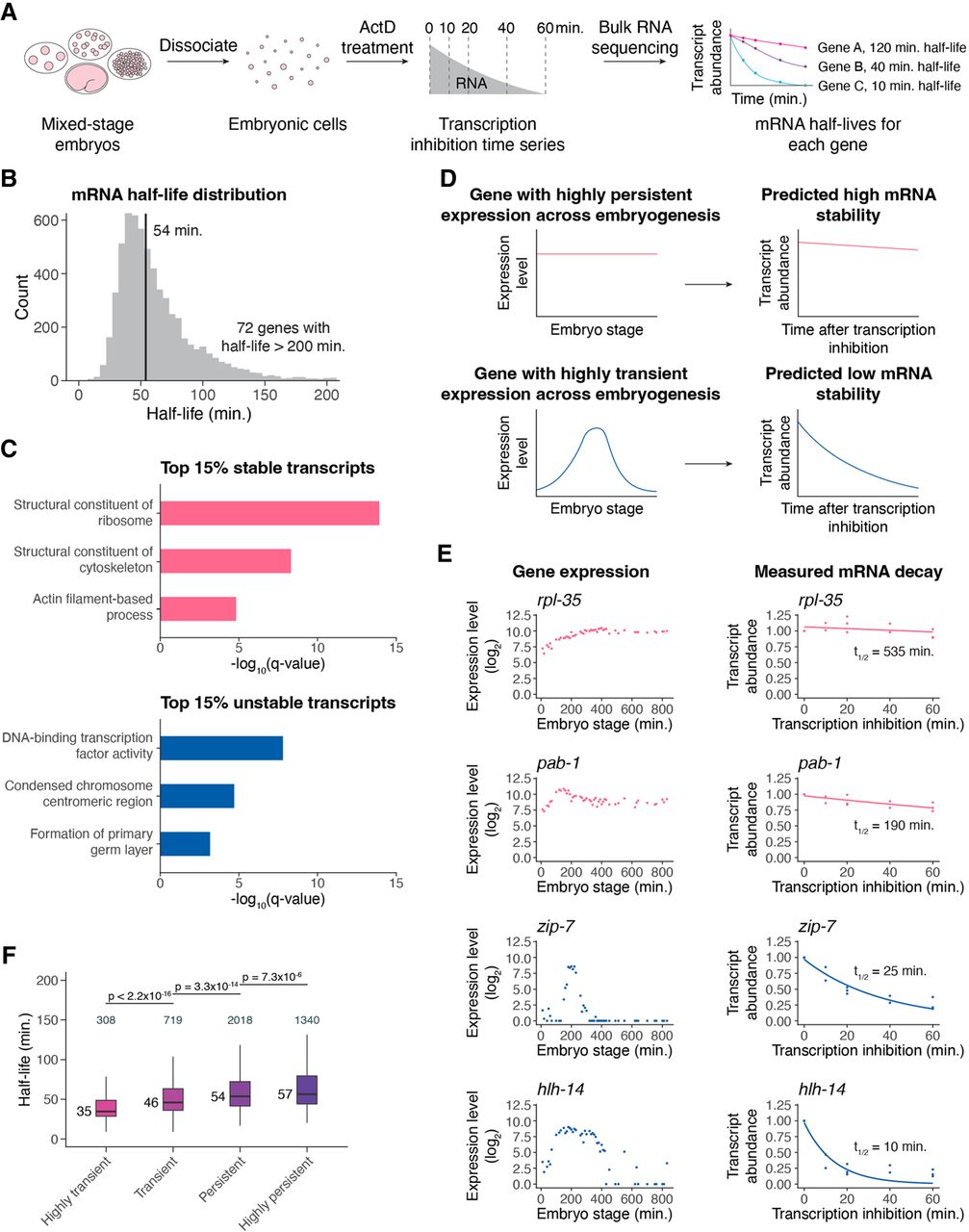
Transcription inhibition by actinomycin D (actD) allows mRNA decay measurements in C. elegans embryonic cells. (A) A schematic representation of the approach to measure mRNA half-lives in the C. elegans embryo using transcription inhibition and bulk RNA sequencing. (B) Distribution of mRNA half-lives across three biological replicates that met a moderate filtering strategy. The median half-life was 54 min (black line). Seventy-two genes with half-lives >200 min are not shown. (C) Select Gene Ontology (GO) categories enriched among the top 15% stable and unstable transcripts. Background set of genes used was all genes that met our moderate mRNA half-life filtering metric. (D) A schematic representation of a gene with highly persistent expression and a gene with highly transient expression and the predicted overall stability of their transcripts. (E, left) Expression over time of highly persistent (rpl-35, pab-1) and highly transient (zip-7, hlh-14) genes from a whole-embryo RNA sequencing time series (Hashimshony et al. 2015). (Right) The measured mRNA decay of the corresponding genes from our bulk RNA sequencing data, with each point representing normalized transcript abundance from one of three biological replicates. (F) Box plots showing the mRNA half-life distributions of genes characterized as highly transient, transient, persistent, or highly persistent transcriptome-wide. Numbers to the left of the box plots are median half-lives within each group. Numbers above the box plots are the number of genes within each group. P-values comparing median half-lives were calculated using the Wilcoxon rank-sum test. Outliers are not shown: From left to right, one, five, 50, and 57 genes within each group had mRNA half-lives >150 min.



