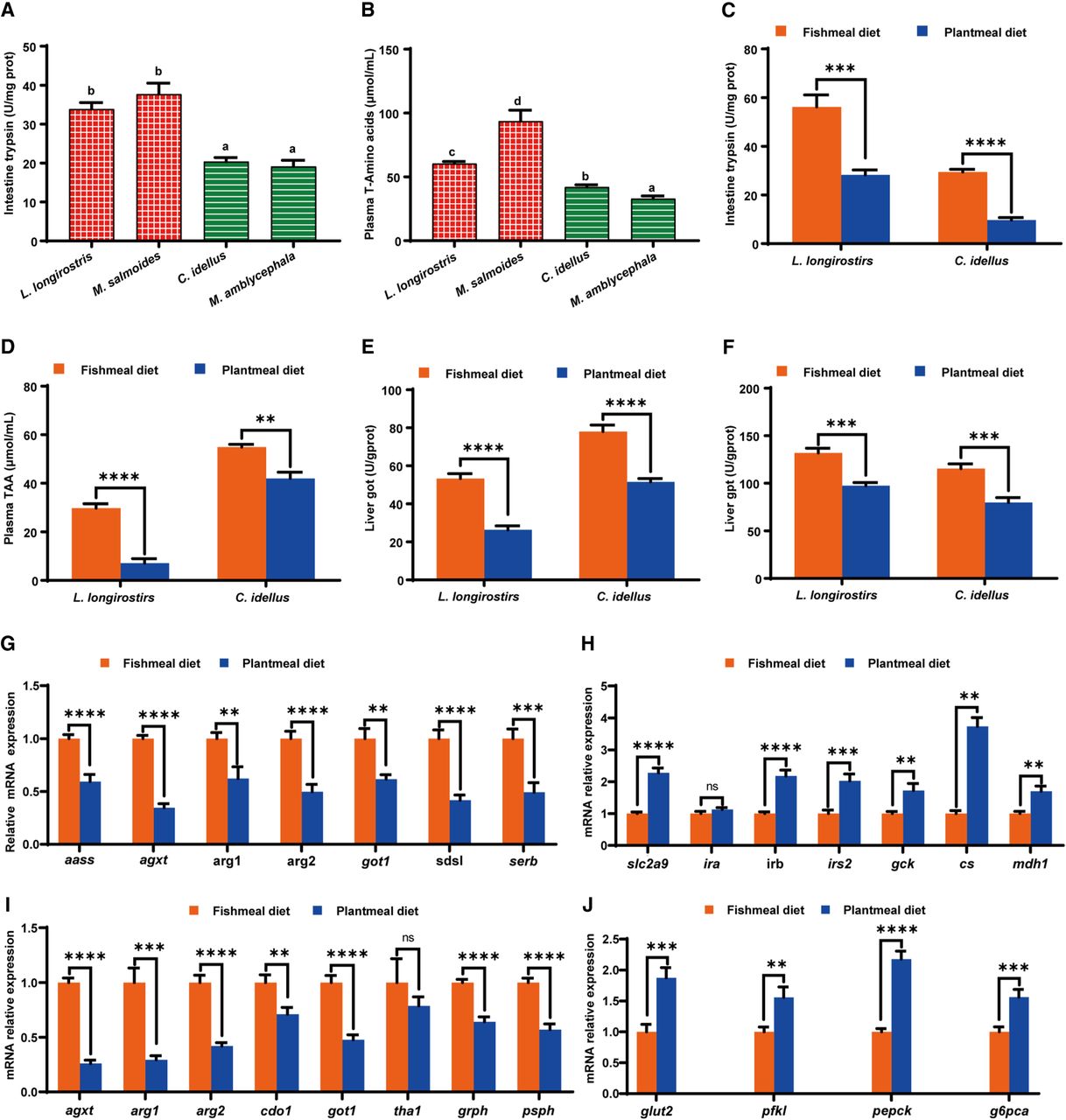
The relationship between feeding preferences and corresponding metabolic strategies in fish with distinct feeding habits. (A,B) Intestinal trypsin activities and plasma TAA contents in two typical carnivorous fish, Chinese longsnout catfish (L. longirostris Günther) and largemouth bass (M. salmoides), and two typical herbivorous fish, grass carp (C. idellus) and blunt snout bream (M. amblycephala) (n ≥ 7). Values marked with different superscripts above the bars indicate significant differences (P < 0.05). (C–F) Intestinal trypsin activities, plasma TAA contents, and GOT and GPT activities of the liver of L. longirostris and C. idellus fed a fishmeal or plantmeal diet, respectively (n = 6). (G,H) Relative expression of hepatic genes related with amino acid metabolism and glucose metabolism in grass carp (C. idellus) fed a fishmeal or plantmeal diet, respectively (n = 12). (I,J) Transcriptional level of hepatic genes related with amino acid and glucose metabolism in L. longirostris fed a fishmeal or plantmeal diet, respectively (n = 12). (ns) not significant, (**) P < 0.01, (***) P < 0.001, (****) P < 0.0001.