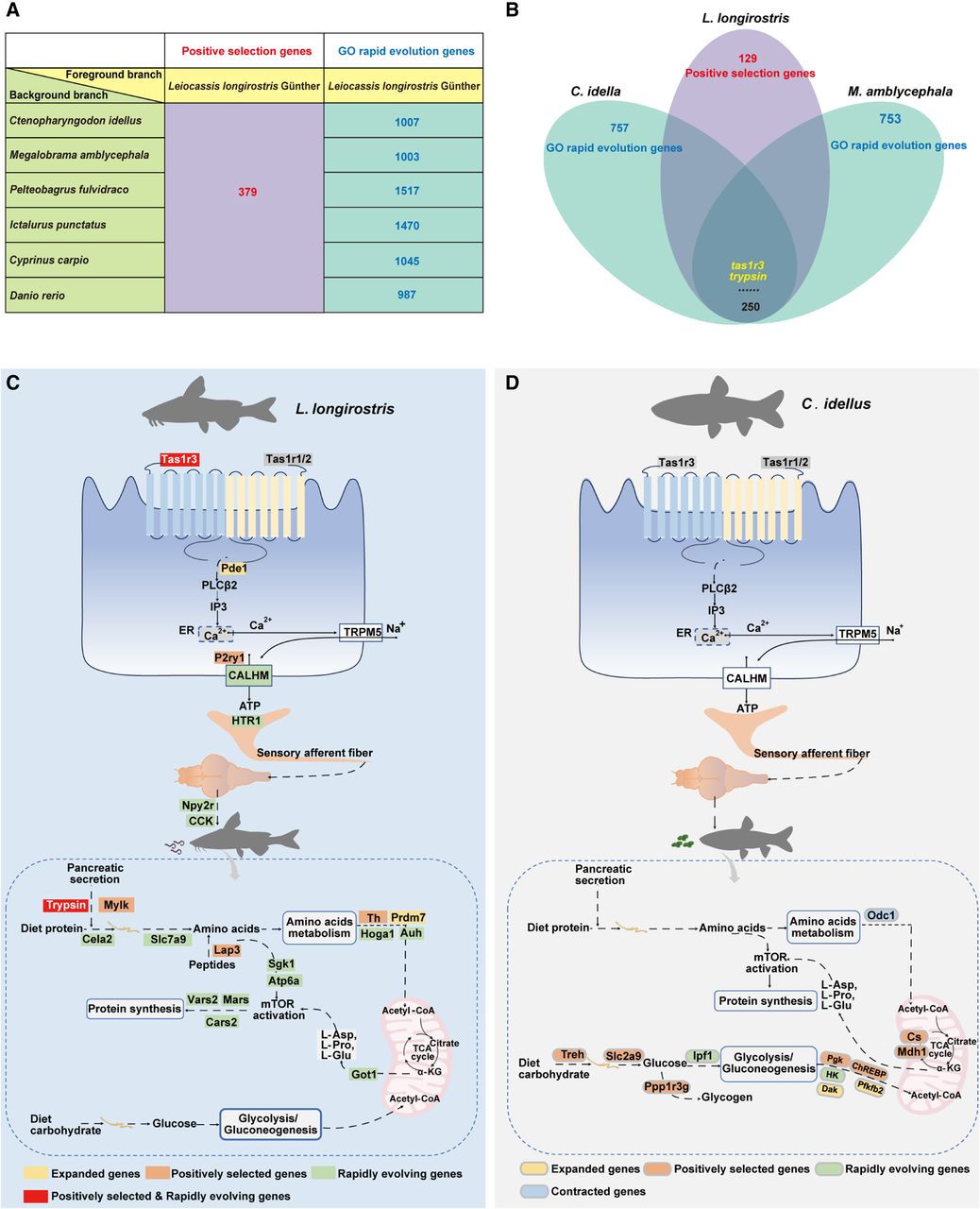
A representative diagram of the joint analysis of rapid evolution and positive selection in L. longirostris Günther. (A) Details of the analysis concerning positive selection and rapid evolution of Chinese longsnout catfish (L. longirostris Günther) compared with grass carp (C. idellus), blunt snout bream (M. amblycephala), yellow catfish (P. fulvidraco), channel catfish (I. punctatus), common carp (C. carpio), and zebrafish (D. rerio). For the positive selection analysis, Chinese longsnout catfish (L. longirostris) was defined as the foreground branch and other fish species as the background branch. The number of genes identified by positive selection is shown in red. For the rapid evolution analysis, the number of genes identified from L. longirostris compared with other fish is shown in blue. (B) List of genes (250 genes) in L. longirostris from the joint analysis of positive selection (379 genes, compared with other six fish) and rapid evolution analysis (1007 genes compared with grass carp; 1003 genes compared with blunt snout bream). (C,D) Diagram of expanded, contracted, positively selected, and rapidly evolving genes related with the feeding preference and corresponding metabolic pathways in Chinese longsnout catfish and grass carp. The genes involved in these pathways are labeled with different colors. The genes represented in orange are positively selected, and those represented in green have evolved rapidly. Genes in red are both positively selected and rapidly evolving. Genes in yellow are expanding, and genes in light blue are contracting.