


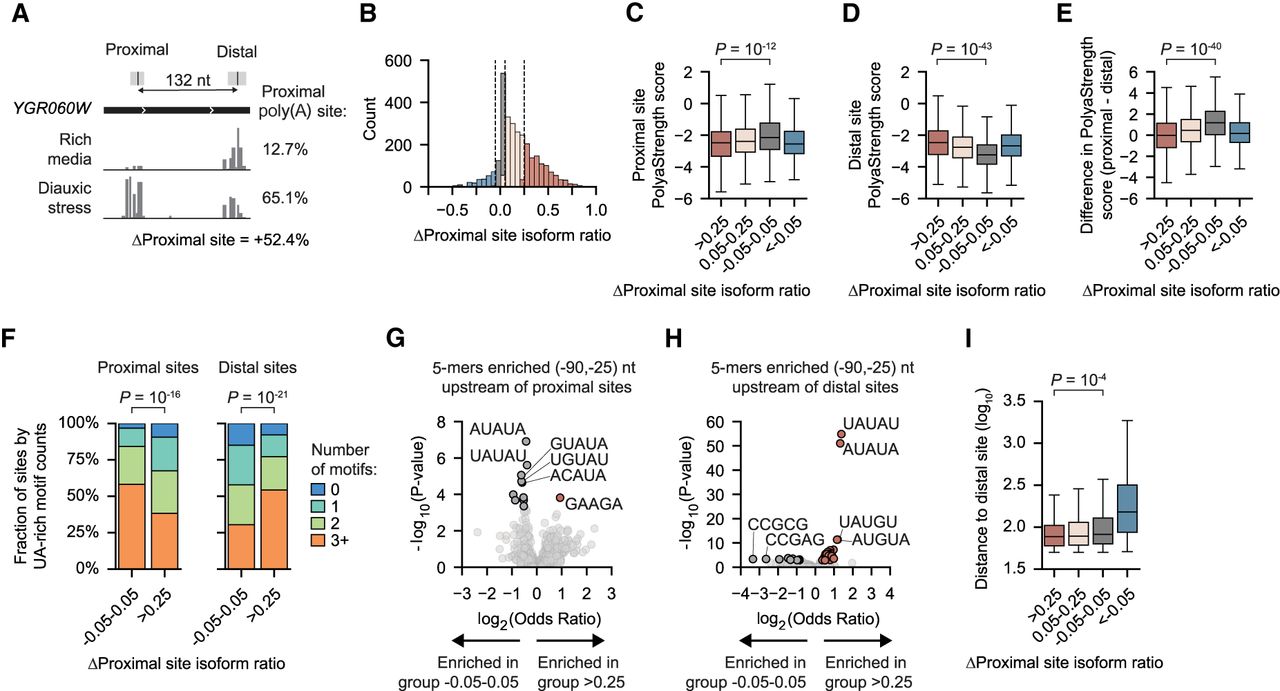
APA regulation under diauxic stress in S. cerevisiae. (A) An example gene YGR060W shows increased usage of proximal poly(A) site under diauxic stress. The proximal and distal poly(A) site clusters are shown above in gray with the maximum cleavage site in each cluster marked with a black line. The distance between representative sites is noted. The proximal poly(A) site isoform abundance ratios in different conditions are shown. (B) The distribution of delta isoform ratios for proximal sites showing different usage under diauxic stress compared with rich media conditions (N = 2976). The vertical dashed lines show the groups of differentially used sites based on their isoform ratio changes. (C) The PolyaStrength scores of the proximal sites grouped by the Δisoform abundance ratios. The P-value from the Wilcoxon rank-sum test comparing the group with a high proximal site shift (Δratio > 0.25) and low Δratio group (–0.05 to 0.05) is shown. (D) Similar to C, except showing the PolyaStrength scores of the paired distal sites. (E) Similar to C, except showing the PolyaStrength score differences between the paired proximal and distal sites. (F) Stacked bar chart showing the number of UA-rich elements present in the [–90,–25] region upstream of proximal (left) and distal (right) sites grouped by Δproximal site isoform ratio. The P-values from the chi-squared test for independence are shown. (G,H) Motif enrichment analysis comparing poly(A) sites in the low Δratio group (–0.05 to 0.05) versus high Δratio group (>0.25). We examined the region [–90,–25] nt upstream of proximal (G) and distal (H) sites. The x-axis indicates the degree of enrichment as measured by log2(odds ratio). Positive values indicate enrichment in the high Δratio group, and negative values indicate enrichment in the low Δratio group. The y-axis shows the −log10(chi-squared test P-value) for the motifs enriched in the high Δratio group and log10(chi-squared test P-value) for ones enriched in the low Δratio group. (I) Similar to C, except showing the distance between the paired proximal and distal sites.


