


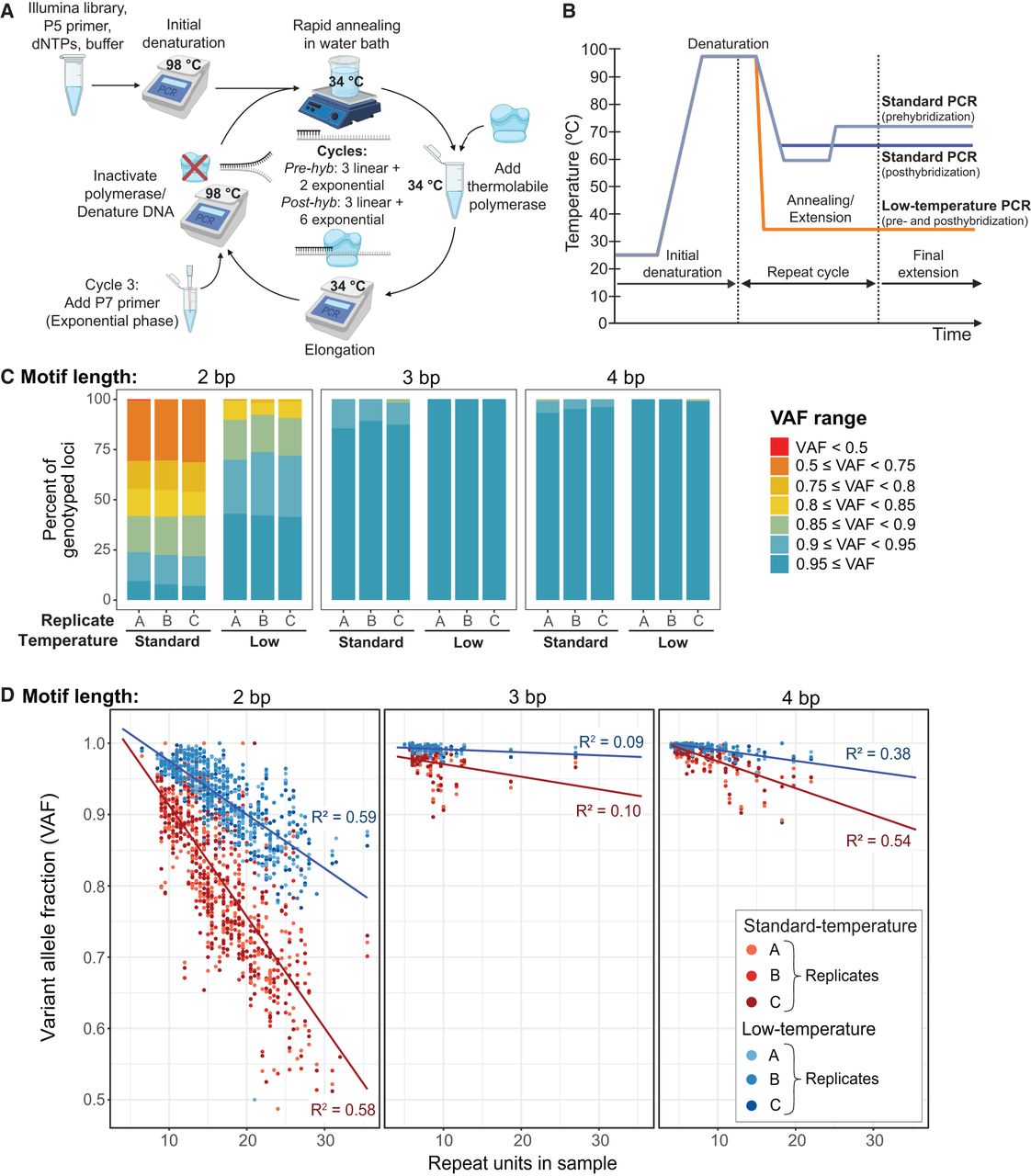
Impact of amplification temperature on microsatellite stutter. (A) Schematic of low-temperature PCR of sequencing libraries that significantly reduces microsatellite stutter artifact. (Pre-hyb) Prehybridization PCR; (Post-hyb) posthybridization PCR. The number of cycles specified is for the large-scale capture panel (Methods). (B) Schematic graph of temperatures during standard and low-temperature PCR protocols. Prehybridization and posthybridization standard PCRs use different thermal cycling protocols. In both standard- and low-temperature PCR, the prehybridization protocol consisted of three linear and two exponential PCR cycles, and the posthybridization protocol consisted of three linear and five exponential PCR cycles. (C) Fraction of genotyped loci on male Chromosome X microsatellite loci in three replicates of sample NA12877 (male) in different bins of variant allele fraction (VAF). Only Chromosome X loci from male individuals are included in the analysis to provide accurate stutter estimates, which is not feasible for biallelic loci. Loci are grouped by motif length, because motif length correlates with mutability. VAF = [number of reads supporting the allele genotyped by HipSTR]/[total number of reads at the locus calculated as the sum of the HipSTR MALLREADS field]. A VAF < 1 indicates stutter reads at the locus. Low-temperature amplification significantly decreased the fraction of loci with high levels of stutter (i.e., with low VAF), most noticeably for 2 bp motifs. (D) VAF of genotyped Chromosome X loci (as calculated in C) versus the number of repeat units called in the sample in three standard-temperature (red) and three low-temperature (blue) amplification replicates of individual NA12877. Red line indicates linear regression for VAF values in the standard-temperature condition; blue line, linear regression for VAF values in the low-temperature condition.


