


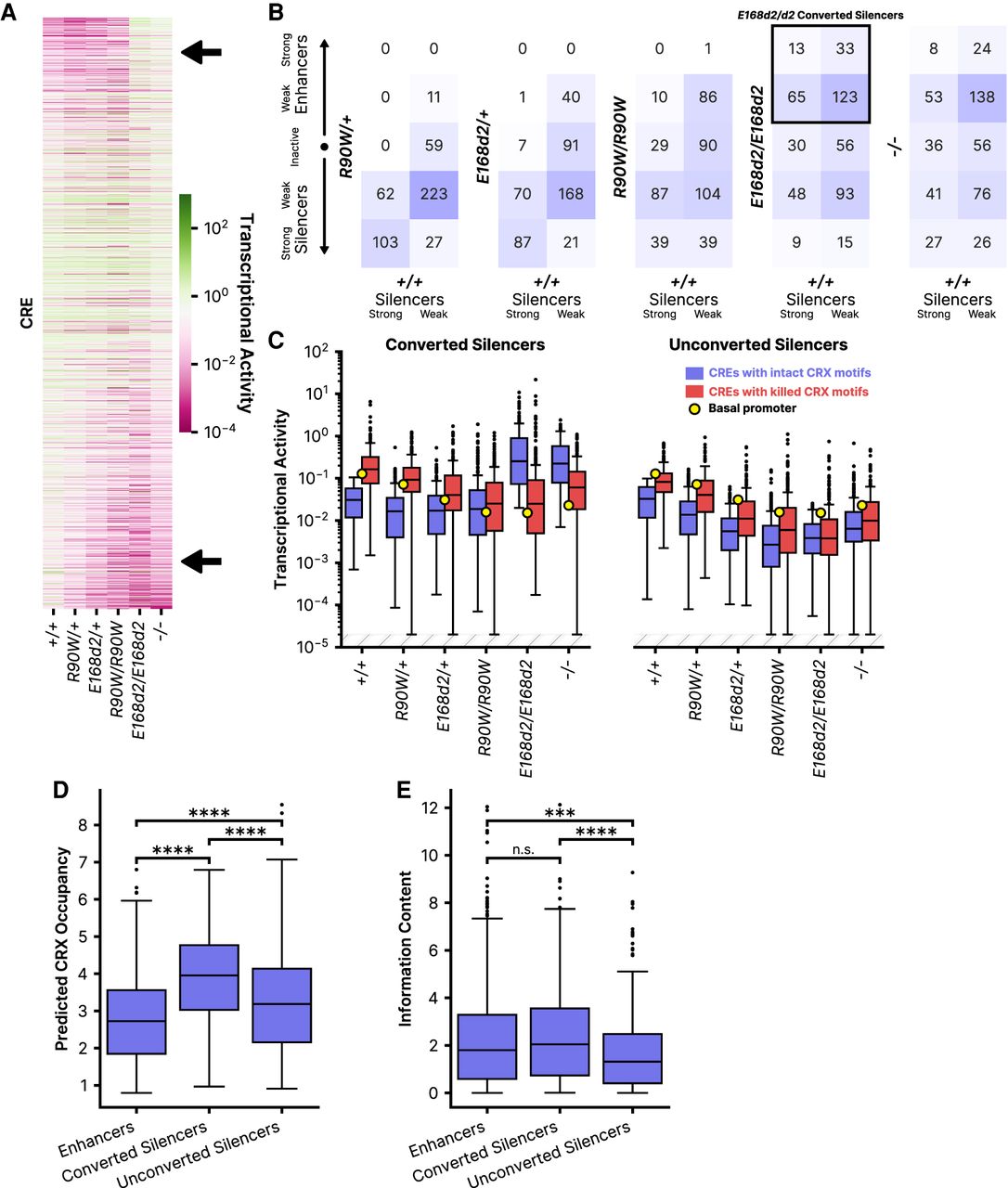
Identification and characterization of silencers that convert to enhancers in Crx mutant genotypes. (A) Heatmap comparing the transcriptional activity of each CRE across the six Crx genotypes. In the top right (upper arrow), note a group of CREs with generally low activity in all but the E168d2/d2 and −/− genotypes. Along the bottom (lower arrow), note the stepwise reduction in activity with increasing phenotypic severity. CREs are sorted by the ratio of transcriptional activity in the +/+ and −/− genotypes. (B) Classifications across genotypes for CREs classified as strong silencers (left column of each heatmap) or weak silencers (right column) in wild-type retinas. (C) Transcriptional activity of wild-type or motif mutant CREs across genotypes for 234 silencers in +/+ that convert to enhancers in E168d2/d2 (converted), or the remaining 251 silencers in +/+ that do not convert to enhancers in E168d2/d2 (unconverted). A yellow dot indicates the transcriptional activity of the basal promoter alone in each genotype. (D) Predicted CRX occupancy of the same silencer subgroups as in panel C and CREs that act as enhancers in +/+. (E) Information content of the same subgroups as panel D. (*) P < 0.05, (**) P < 0.01, (****) P < 0.0001 via two-sided Mann–Whitney–Wilcoxon test. In panel C, transcriptional activity was adjusted for visualization purposes using a fixed pseudocount of 2 × 10⁻⁵; the out-of-bound region is indicated by the light gray stripes.



