


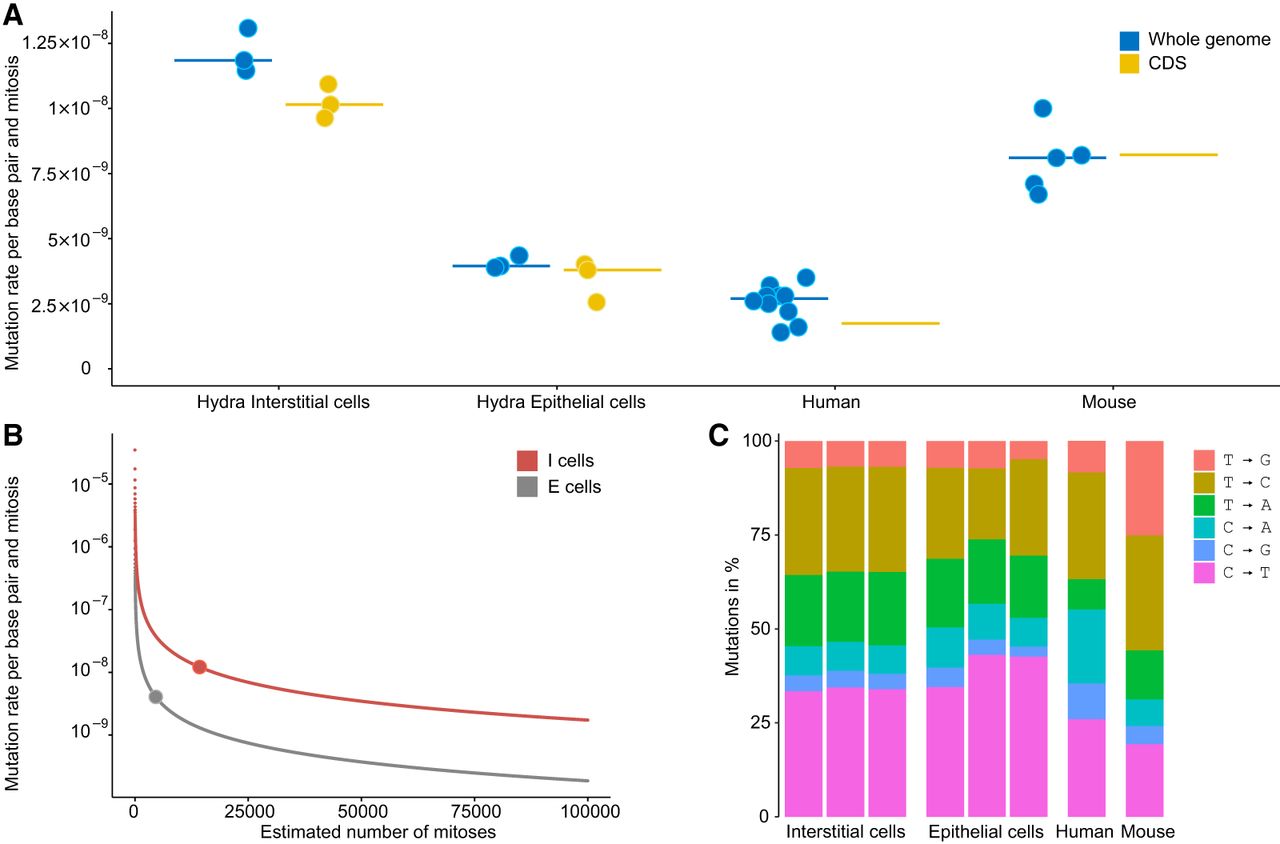
Single-cell whole-genome analysis to determine the mutation rate per cell division in Hydra. (A) Mutation rates per cell division in Hydra I cells and E cells in genome and coding sequences (CDS) compared with literature data for human and mouse dermal fibroblasts (Milholland et al. 2017). Points represent single sample estimates, lines denote medians (Supplemental Table S2) (for CDS of human and mouse only averages were published). (B) Dependence of mutation rate estimates on the number of mitoses since the zygote. Larger dots represent predicted mutation rates shown in A based on our estimated numbers of mitoses—14,292 and 4605 for I cells and E cells, respectively. (C) Mutation spectra in Hydra of the three I cells and three E cells compared to literature data for human and mouse dermal fibroblasts (Milholland et al. 2017).



