


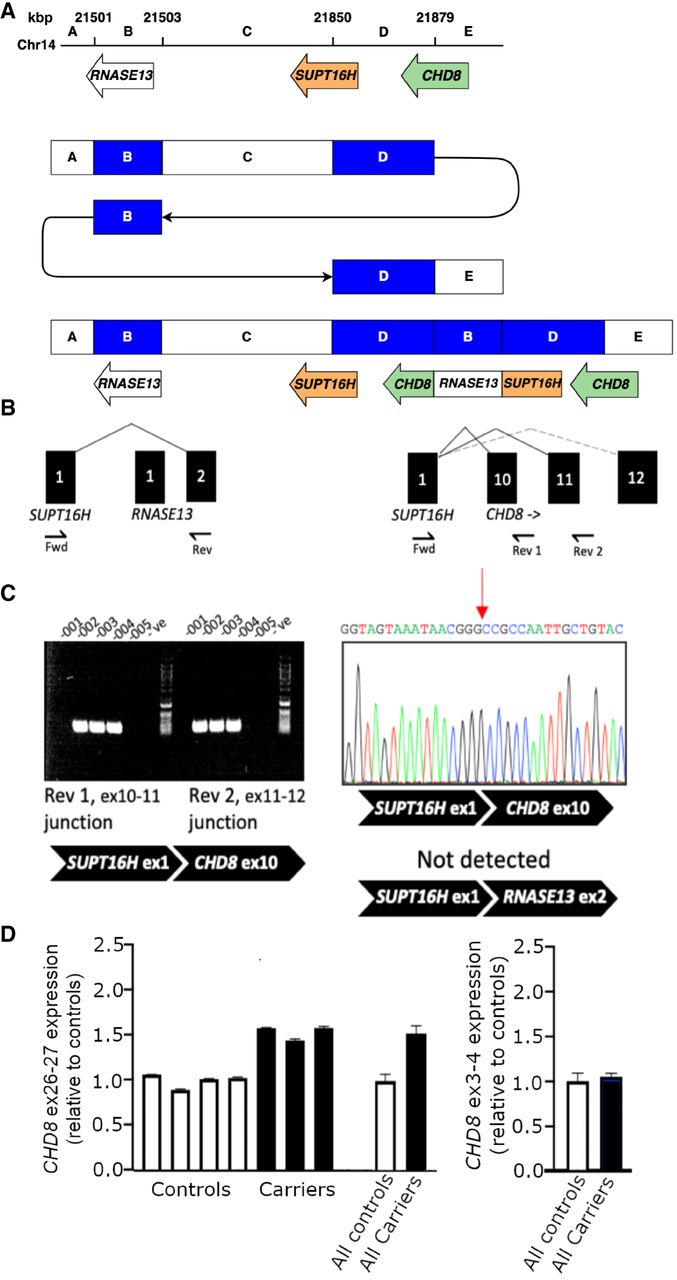
SUTP16H–CHD8 fusion transcript. Functional analysis of the CGR affecting CHD8. (A) Schematic representation of the SUTP16H–CHD8 rearrangement. (B) Alternately spliced products are predicted from the gene fusion. Predicted in-frame (solid line) and frameshift (dotted line) products are indicated. A targeted Fwd–Rev 1 assay was used in addition to a Fwd–Rev 2 assay, the latter being sufficient to detect both potential splicing events. (C) The amplification of PCR products was used to assay SUPT16H–CHD8 exon 10 and exon 11 splicing events. The sequence corresponding to the detected splicing event between SUPT16H exon 1 and CHD8 exon 10 is shown. (D) Average relative fold-change in gene expression of exons within the duplicated 3′ end of CHD8, and upstream exons.



