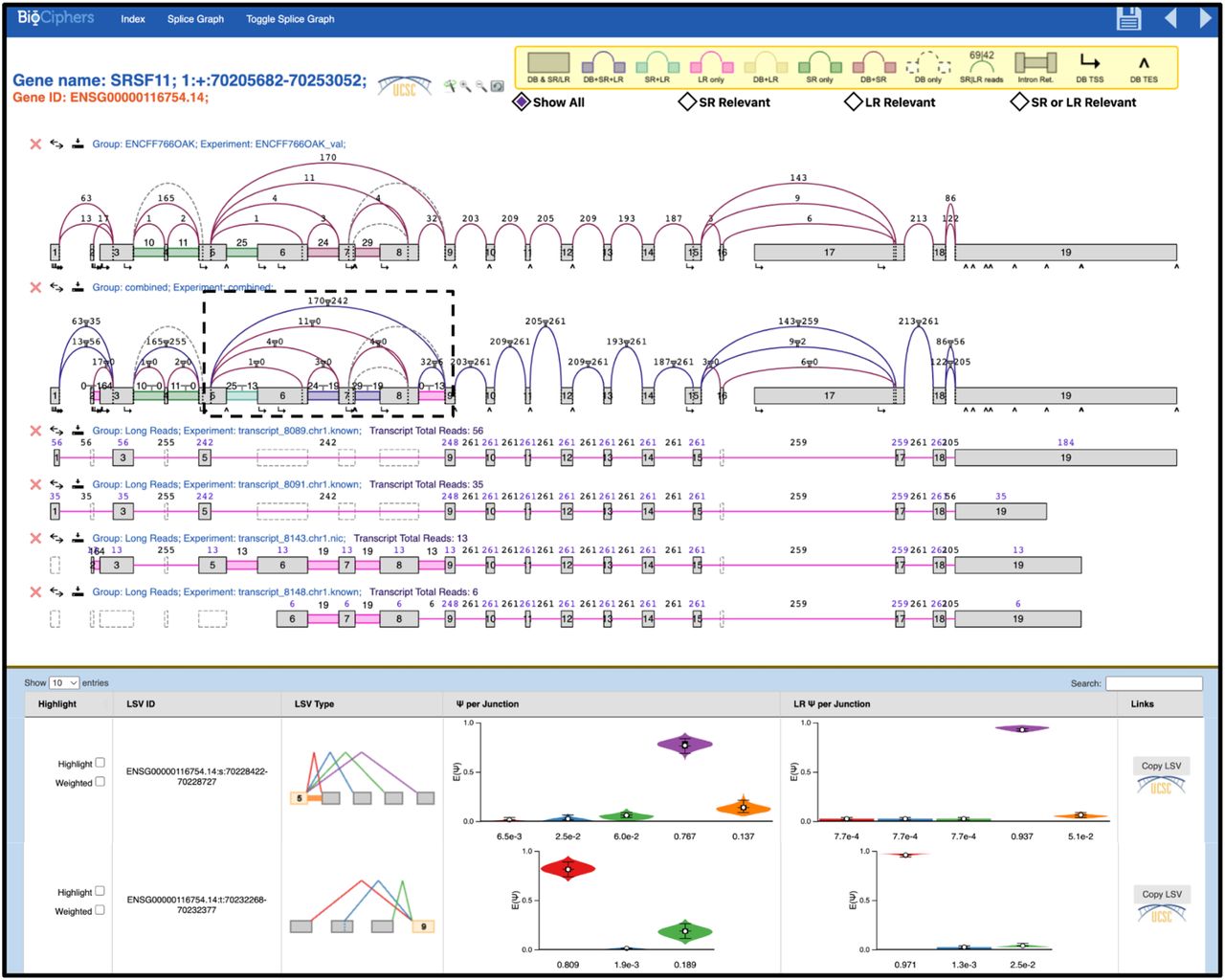
MAJIQ-L integrative analysis of splicing variations using short and long reads. Snapshot of the VOILA v3 interactive visualization of MAJIQ-L output for the SRSF11 splice factor using the LRGASP data, including short reads processed by MAJIQ and PacBio reads processed by IsoQuant. The top portion shows gene information and filtering criteria between short and long reads as well as the short-read splicegraph, a unified splicegraph, and a list of transcripts reported by IsoQuant for SRSF11. Read numbers for each transcript and the marginal count for each specific element (junctions, introns, and exons) are included. In the unified splicegraph view, read counts for junctions and introns are shown for both short (left) and long (right) reads, separated by a T sign. Note that pTSSs/pTESs are only shown in transcripts found by long reads. The bottom portion shows distributions of E(Ψ) values of LSV that both short and long reads find, displayed as a violin plot for the exon 5–source LSV and exon 9–target LSV in the black dotted box. The source of the individual junction can be highlighted by hovering the cursor over the junction, and multiple filters can be applied interactively.