


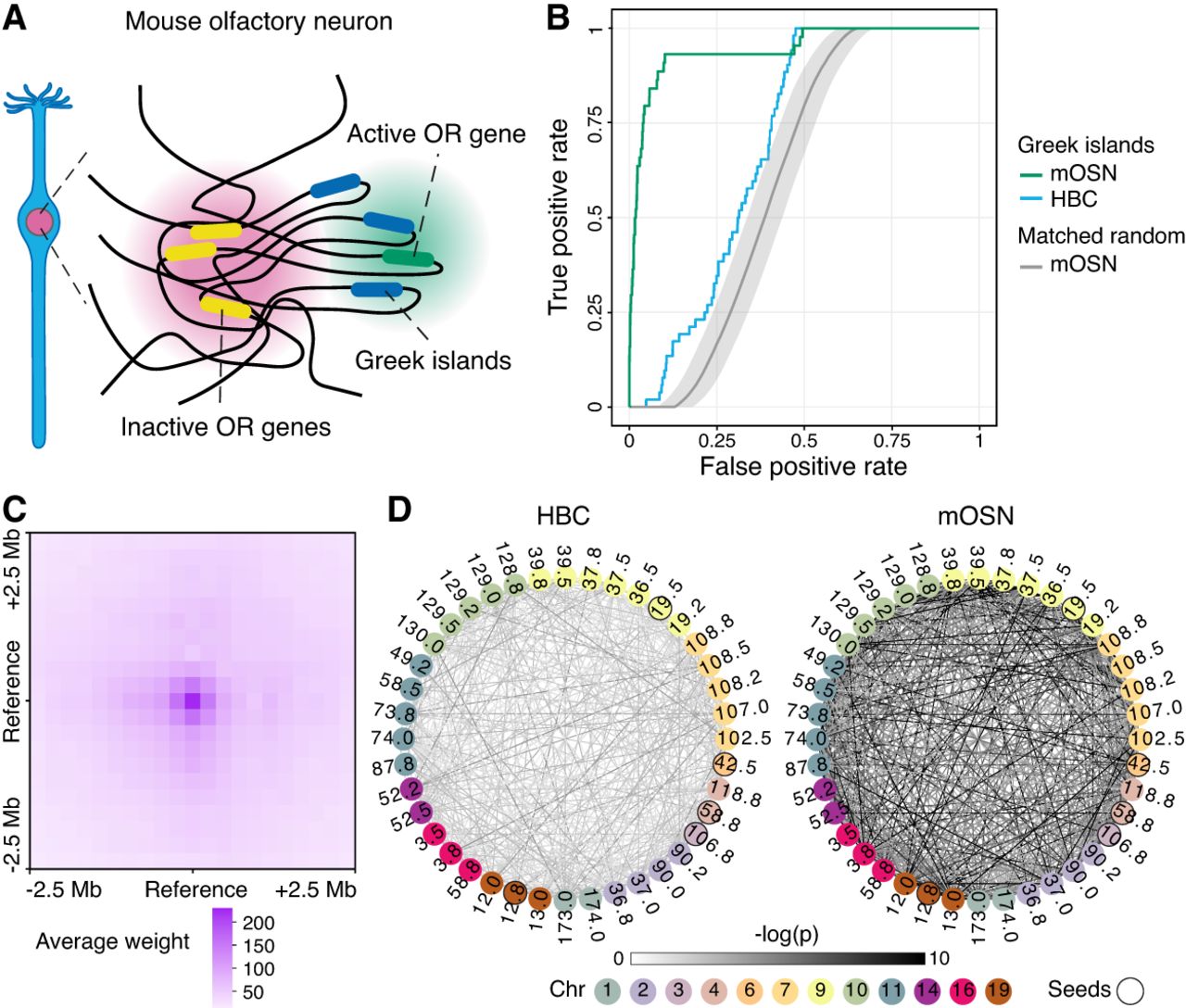
Trans-C identifies the Greek island cluster in mouse olfactory sensory neurons (mOSNs). (A) Schematic of trans contacts in a mOSN. The Greek islands form a multienhancer hub that is segregated from the inactive olfactory receptor (OR) genes. (B) Performance evaluation of trans-C-mediated identification of Greek island clustering. We plot the ROC curve for α = 0.5 in mOSNs versus their progenitors (horizontal basal cells [HBCs]). Trans-C correctly identifies Greek island clustering specifically in mOSNs in a way that is statistically significant (P = 6 × 10−194) versus a matched random seed null model (average and 95% confidence interval from 1000 runs). (C) Aggregated heatmap of trans contacts among the top 60 loci selected by trans-C in mOSNs. Each square in the grid represents an average 250 kb bin in a Hi-C matrix of 21 × 21 bins centered at each interacting pair of loci (reference). The exhibited spot-like structure highlights the highly specific nature of the interchromosomal interactions of the Greek islands. (D) Visualization of the Greek island-associated trans clique identified in mOSNs by trans-C, showcasing the increased significance of loci interactions after differentiation of HBCs, plotted as described for Figure 2D.



