


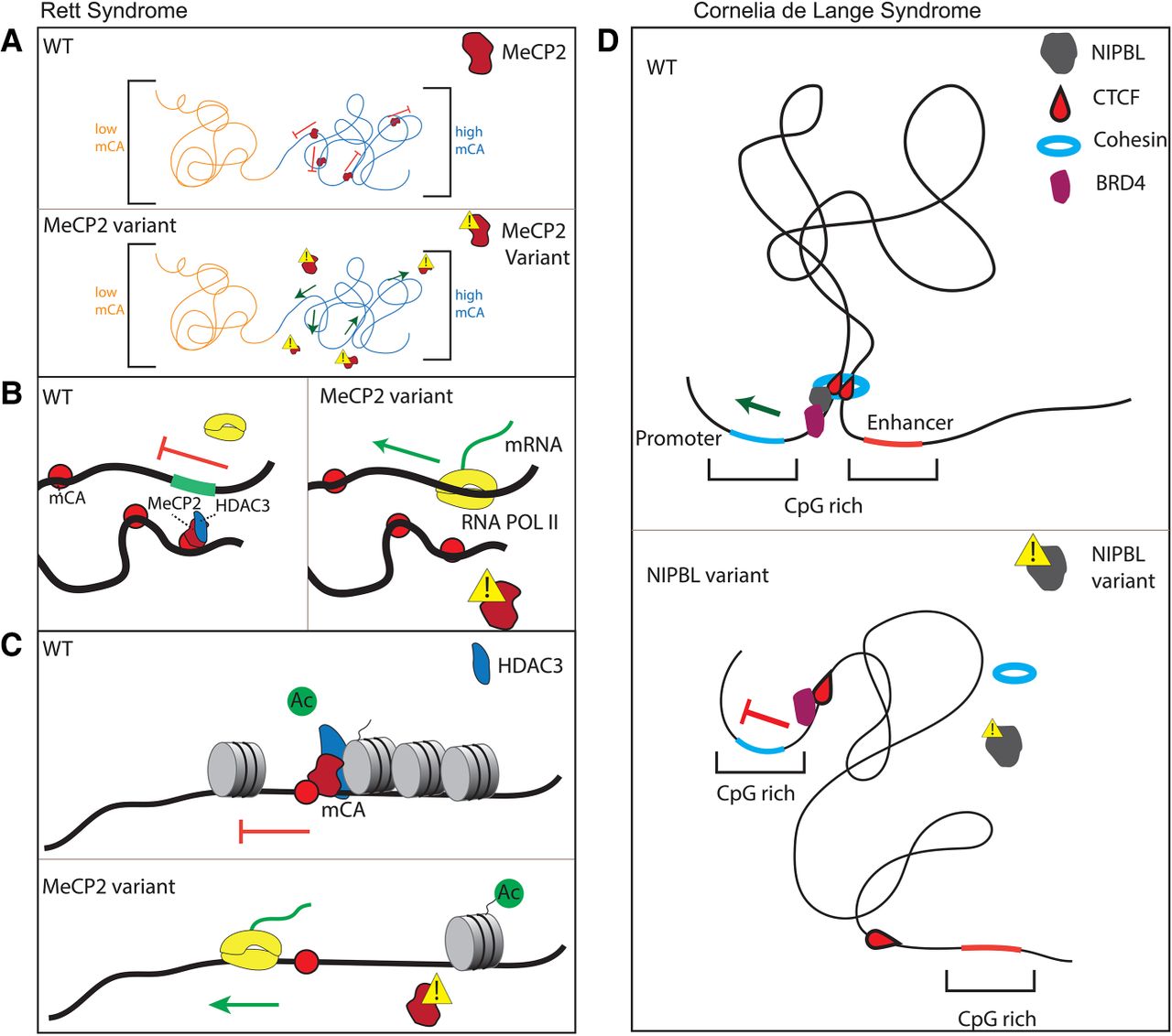
Examples of known chromatin aberrancies in neurodevelopmental disease. Rett syndrome (left), caused by an MeCP2 variant, is associated with differential gene repression. (A) MeCP2 usually represses regions with high CA methylation (blue) in the B compartment, but the variant cannot bind and repress these sites. (B) MeCP2 can repress RNA polymerase II initiation, even when bound within the gene body, downstream from the TSS. Interactions between the TSS and gene body could provide a means for this long-range transcriptional repression. The MeCP2 variant does not repress these genes. (C) MeCP2 binds to mCA and recruits HDAC3 (blue), which alters the accessibility of the surrounding chromatin, preventing RNA polymerase II initiation. The MeCP2 variant does not bind these sites, allowing the chromatin landscape to remain accessible. (D) CdLS is a cohesinopathy often due to a NIPBL variant. NIPBL (gray) loads cohesin onto chromatin, whereafter, cohesin-mediated (blue) chromatin extrusion forms loops between CTCF (red) sites. This could bring promoters and enhancers into 3D contact to facilitate transcription. NIPBL may also help with BRD4 (purple). The NIPBL variant disrupts BRD4 occupancy and cohesin loading, likely impacting extrusion, CTCF looping, and E–P regulation. Note that this is a model of events, and the various mutations associated with CdLS may impart distinct impacts to chromatin loops.



