


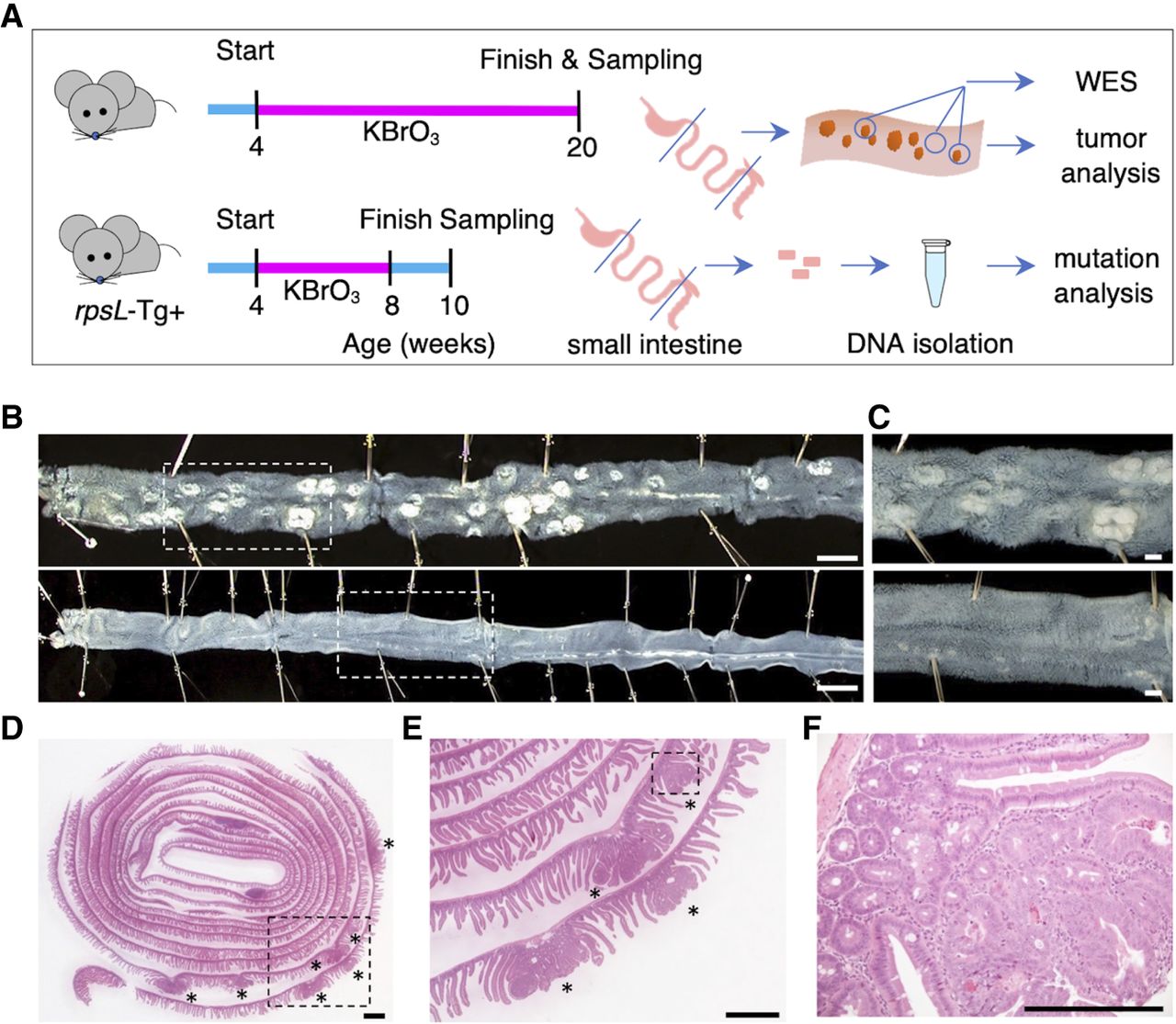
Experimental design and tumor analysis. (A) Experimental design of KBrO3 administration. Schedule for tumor analysis (upper) for rpsL mutation analysis (lower). Blue and magenta lines indicate the administration period of regular water or KBrO3-containing water, respectively. (B) Formalin-fixed small intestines (duodenum to ileum, right to left) collected from 0.15% KBrO3-treated mice. Upper panel: specimens from Mutyh−/− mouse. Multiple tumors (white spot-like parts) are observed. Lower panel: specimens from Mutyh+/+ mouse. No visible tumor was observed. Scale bars indicate 1 cm. (C) Magnified images of B. The scale bar indicates 1 mm. (D–F) HE-stained section of StR of the small intestine (Supplemental Methods) of 0.15% KBrO3-treated Mutyh−/− mice. The scale bar indicates 1 mm. (D) Multiple tumors (asterisks) at the outer side correspond to the region of the duodenum and jejunum. (E) Magnified view of the marked area in D, with >1-mm sized tumors (polyp-like form) among normal villi. (F) Magnified view of the marked area in E.


