


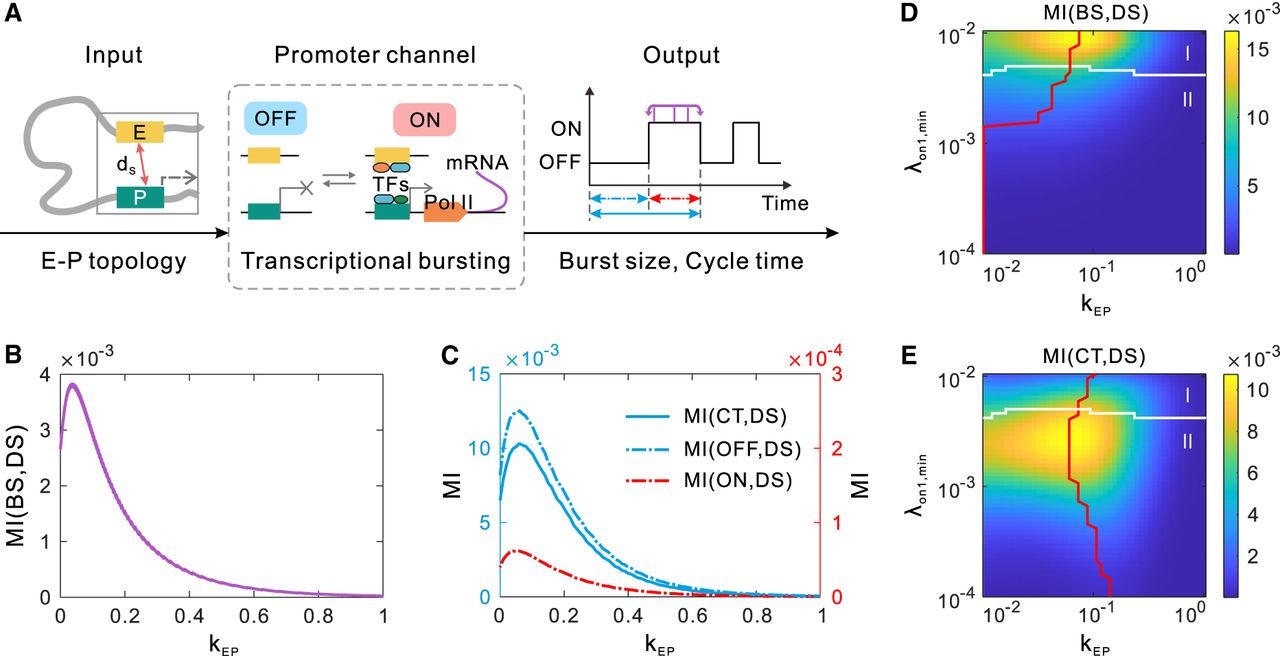
Mutual information reveals the effect of E-P communication on bursting kinetics. (A) An information theoretic framework is used to study the effect of input E-P topology on bursting output. The promoter governing transcriptional bursting can be considered a noisy channel. (B) Mutual information between E-P spatial distance and burst size (MI(BS, DS)) as a function of E-P communication strength kEP. (C) Mutual information between E-P spatial distance and cycle time (or OFF time, ON time) as a function of kEP. (D,E) Heatmap shows the effect of kEP and minimum rate λon1,min on MI(BS, DS) (D) and on MI(CT, DS) (E). The red line shows the values of kEP obtained from the MMIs with different λon1,min. The white line is the separatrix between the values of MI(BS, DS) and MI(CT, DS). Region I stands for MI(DS, BS) > MI(DS, CT); region II, for MI(DS, BS) < MI(DS, CT).



