


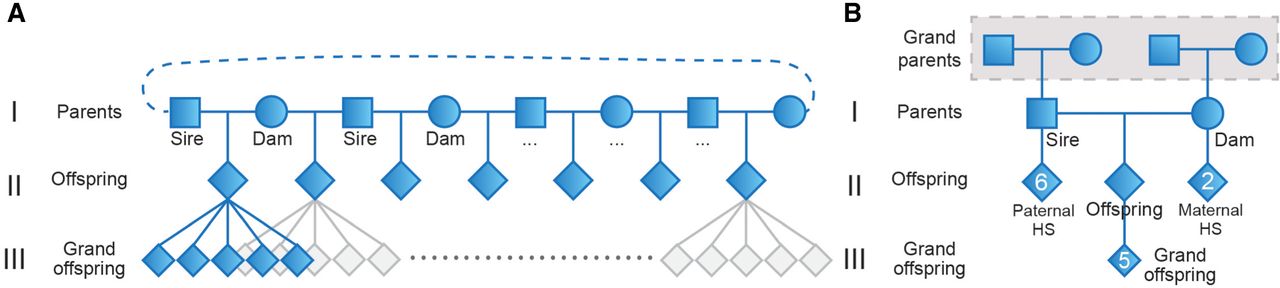
The Damona pedigree structure. (A) A sire is bred with multiple dams and vice versa. Using this feature, we minimized the number of animals to be sequenced while increasing the number of independent three-generation pedigrees. Squares and circles mark sires and dams, respectively (first generation). Diamonds mark offspring (second generation) and grand-offspring (third generation) of unspecified sex. (B) Example of a Damona pedigree. Each pedigree consists of a minimum of three generations (parents, offspring, and grand-offspring). Some pedigrees have grandparents available, making four-generation pedigrees (marked with a dotted gray box). The numbers indicate the average number of animals per pedigree (six paternal half-sibs [HS], two maternal HS, and five grand-offspring per offspring).



