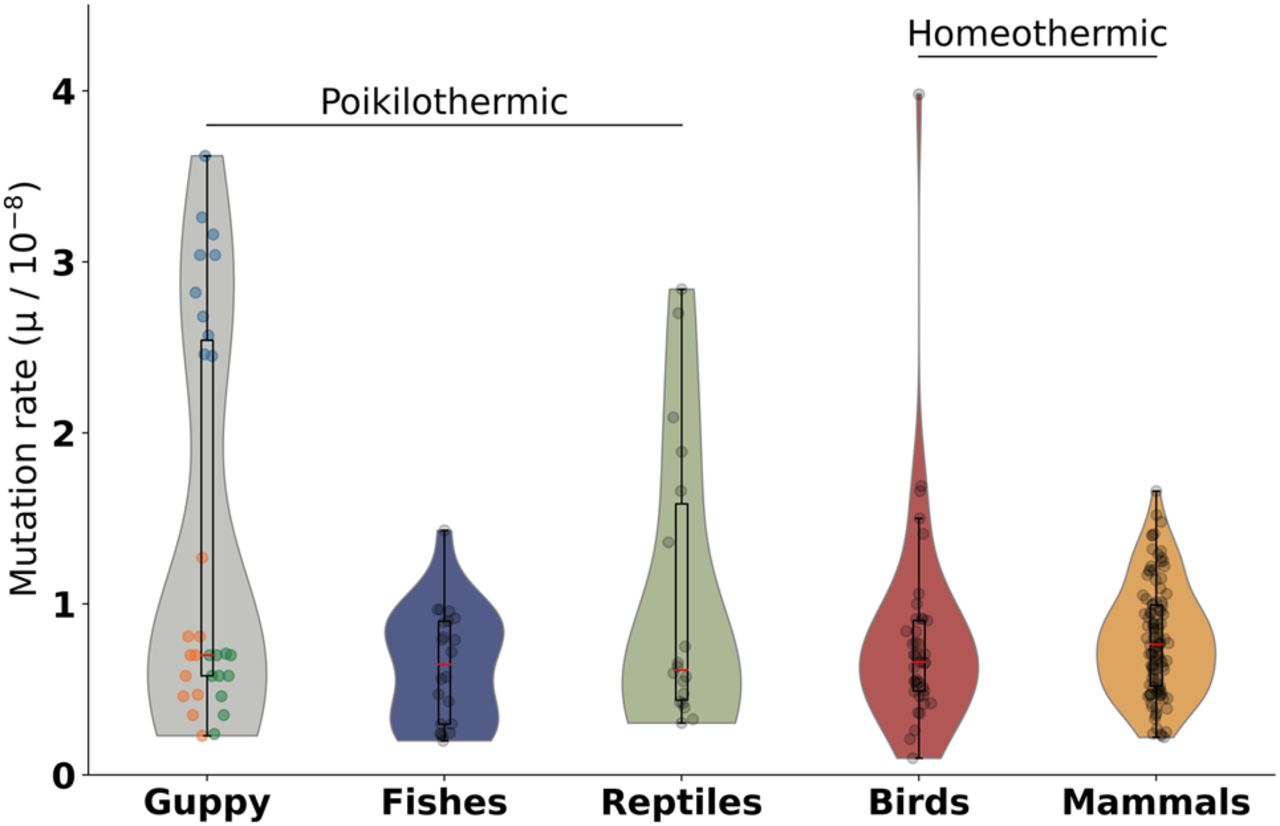
Distribution of trio DNMs in different animals. Distribution of trio DNM rate across different groups of poikilothermic animals, including fishes and reptiles, and homeothermic animals, including birds and mammals. Each data point represents a DNM rate in a parent-offspring trio. Three families in the guppy categories: Fam1 (orange), Fam2 (blue), and Fam3 (green). More details can be found in Supplemental Table S10. Data points from Awadalla et al. (2010); Bergeron et al. (2022, 2023); Besenbacher et al. (2015); Campbell et al. (2021); Conrad et al. (2011); Feng et al. (2017); Harland et al. (2017); Jónsson et al. (2017); Koch et al. (2019); Kong et al. (2012); Lindsay et al. (2019); Martin et al. (2020); Pfeifer (2017); Rahbari et al. (2016); Roach et al. (2010); Smeds et al. (2016); Tatsumoto et al. (2017); Thomas et al. (2018); Venn et al. (2014); Wang et al. (2020, 2022); Wu et al. (2020).