


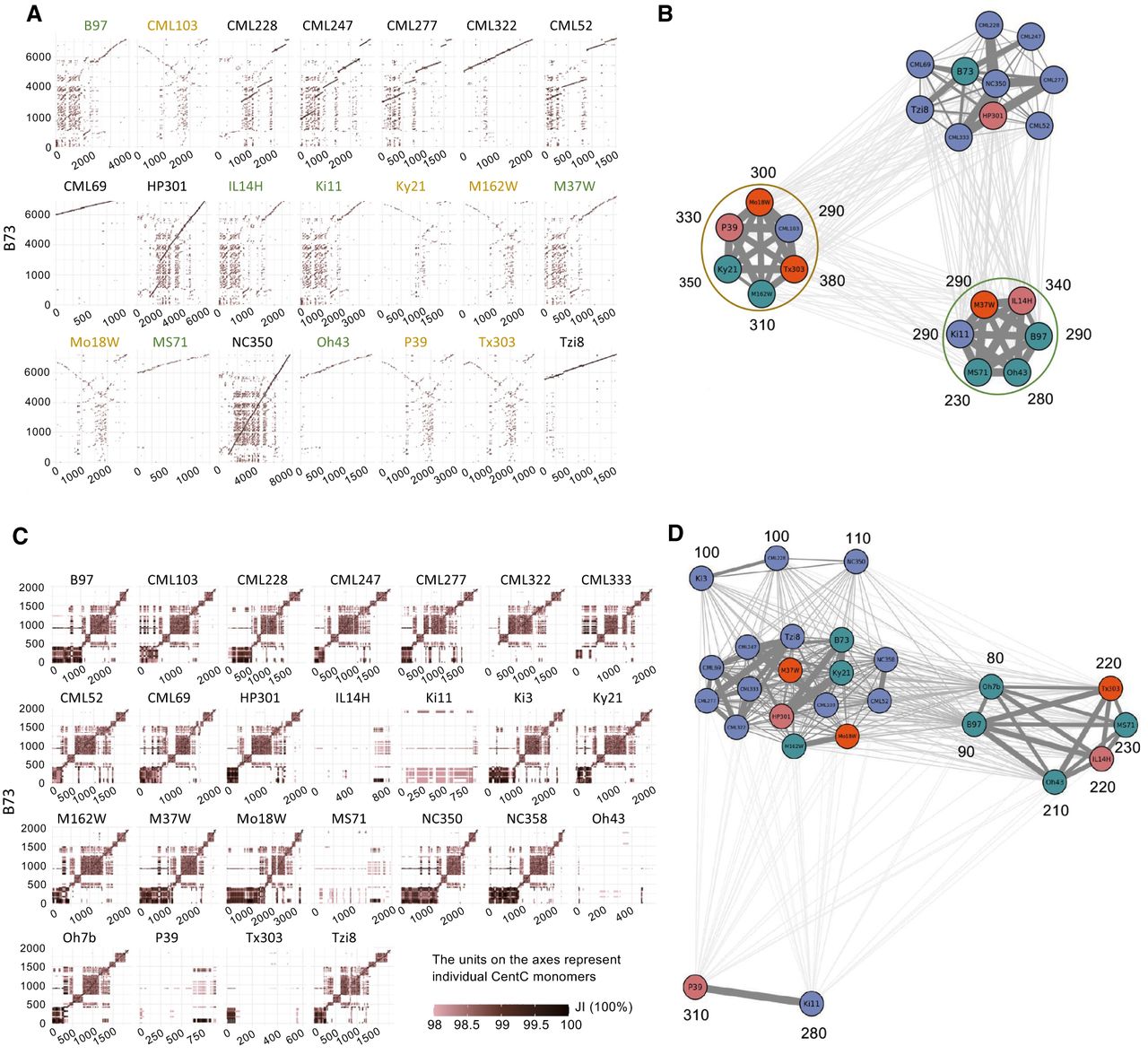
Ancient haplotypes in the 9S knob and NOR. (A) Dot-matrix alignments between 21 NAM lines and B73 over the knob180 array on Chromosome 9S (only 21 have the 9S knob). x- and y-axes show knob180 monomers, and color intensity reflects the Jaccard index between each monomer pair. (B) Clustering of 9S knobs based on repeat array alignments. Divergence times from B73 (kya) were calculated using syntenic SNPs in TEs that lie within the arrays. In panel A the non-B73 haplotypes are indicated in olive and green, and the corresponding clusters in B are circled in matching colors. (C) Dot-matrix alignments between 25 NAM lines and B73 over the NOR. x- and y-axes show 18S rDNA monomers, and color intensity reflects the Jaccard index (JI) between each monomer pair. (D) Clustering of the 6S knob180 array that is about 10 Mb from the NOR on Chromosome 6. The TEs in the knob were dated using syntenic SNPs. In B and D, the colors over individual inbred names indicate varieties of corn: northern flint (pink), temperate (blue), mixed (red), and tropical (green).



