


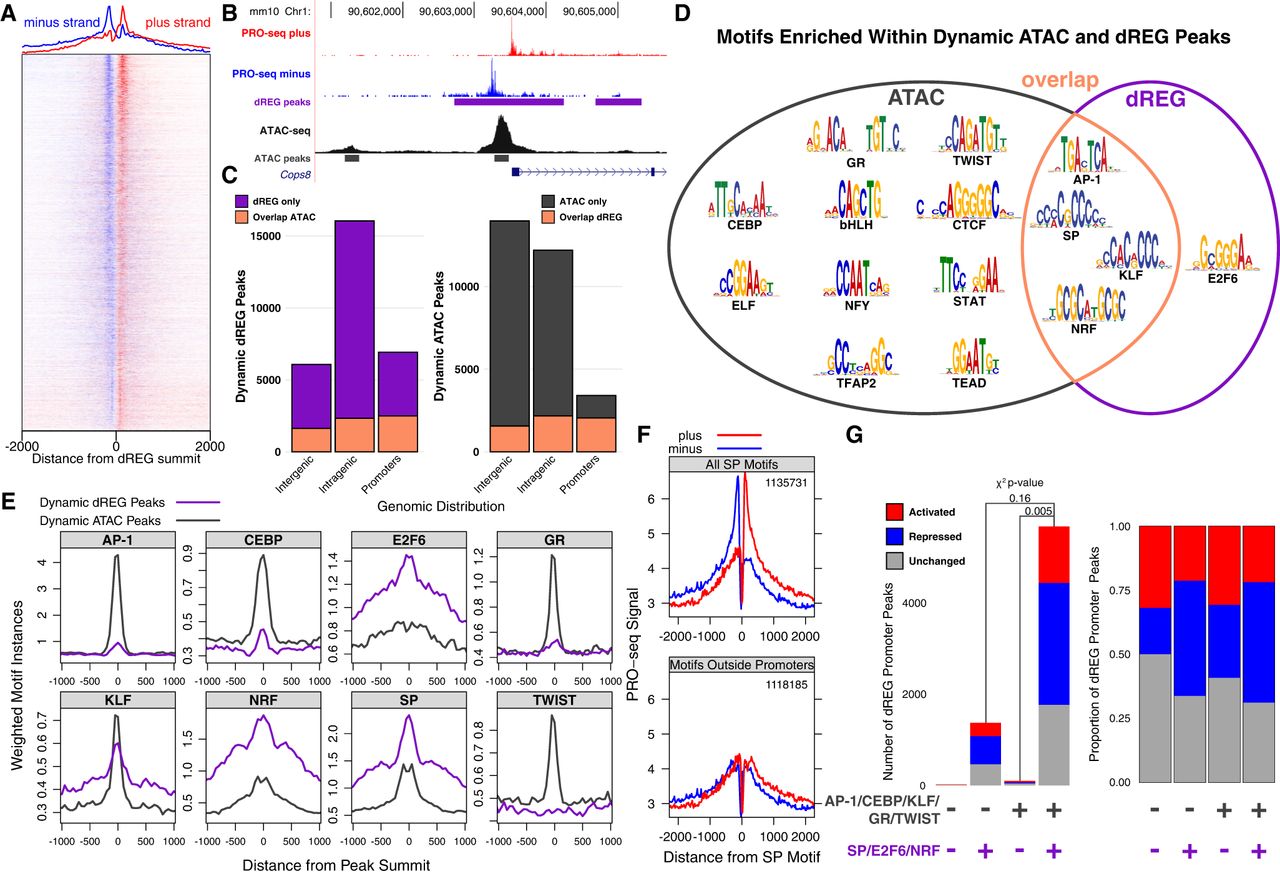
SP, NRF, and E2F6 TF families drive bidirectional transcription dynamics at regulatory regions within gene bodies and promoters. (A) The heatmap illustrates more than 200,000 putative REs with a bidirectional transcription signature. (B) Both dREG and ATAC-seq identify a RE within the promoter of Cops8. The intragenic RE is only identified by its bidirectional PRO-seq signature, whereas the upstream intergenic RE is only identified by ATAC-seq. (C) Dynamic ATAC-seq- and dREG-defined REs largely overlap in promoter regions. Intragenic regions are defined based on primary transcript annotation of PRO-seq data; promoters are between 150 bp upstream of and 50 bp downstream from TSSs; and intergenic regions are the remainder of the genome. (D) Dynamic ATAC-seq peaks are enriched for a more diverse set of TF motifs than are dynamic dREG peaks. (E) Motif density distinguishes TFs associated with dynamic bidirectional transcription from those associated with dynamic accessibility. For example, TWIST and GR motifs are enriched within dynamic ATAC-seq peaks but are rarely found within dynamic dREG peaks. (F) SP is only associated with bidirectional transcription at promoters and not distal REs. The top plot shows the average normalized PRO-seq signal for plus and minus strands around all 1,135,731 SP motif instances, and the bottom plot displays all SP motifs excluding those in promoters (1,118,185). The distinct dual peak profile of bidirectional transcription collapses when only considering SP motifs outside promoters. (G) Dynamic bidirectional transcription peaks found in promoters are stratified by the presence or absence of TF motifs. The left plot quantifies the total number of peaks, and the right plot scales to the proportion of peaks in each category. The x-axis factor motif categories are defined by the presence or absence of ATAC-associated factors (AP-1, CEBP, GR, KLF, and TWIST) and dREG-associated factors (SP, E2F6, and NRF). dREG-associated factor motifs are enriched in peaks that decrease bidirectional transcription, suggesting a link between SP, NRF, and E2F6 factors and an early and pervasive decrease in promoter initiation at their target genes.



