


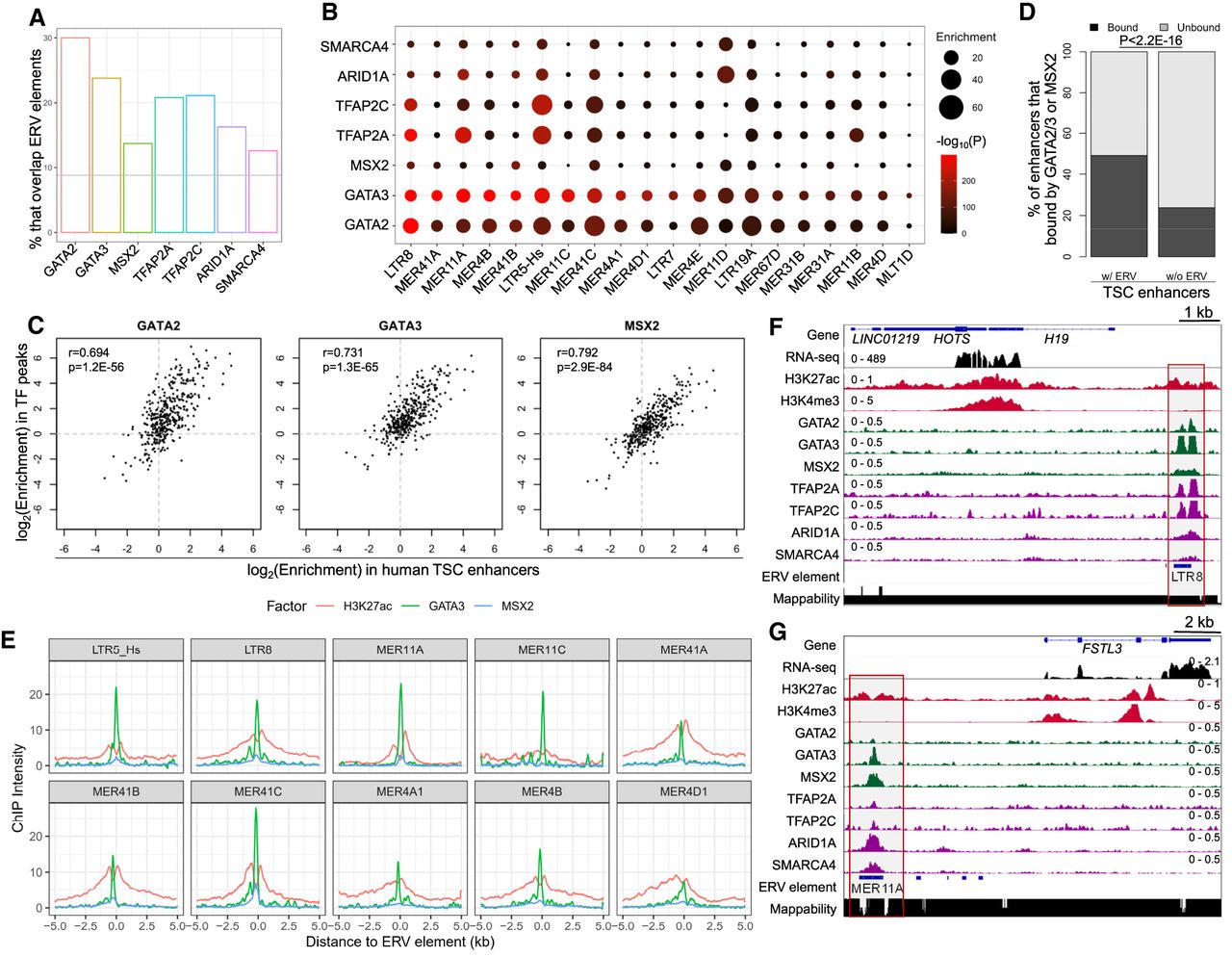
Binding of GATA2/3 and cofactors on different families of ERV-associated enhancers in human TSCs. (A) Percentages of the peaks that bind ERV elements for GATA2/3, MSX2, and cofactors. The gray line represents the expected percentage calculated through the comparison of the randomly shuffled peaks (after pooling the peaks for GATA2/3, MSX2, and cofactors) against ERV elements. (B) Enrichment of the top 20 ERV families that have enriched binding by GATA2/3, MSX2, or cofactors. These ERV families are selected based on the ranking according to the enrichment P-values against the TF peaks. (C) Correlation for the ERV enrichment in annotated enhancers versus GATA2/3 and MSX2 peaks. (D) Comparison of the percentages of enhancers (with or without ERV overlapping) that are bound by at least one TF among GATA2/3 and MSX2. P-value calculated by Fisher's exact test is denoted. (E) Averaged profiles show the intensity of H3K27ac, GATA3, and MSX2 occupancy on the top ten ERV families that have enriched binding by GATA2/3, MSX2, and cofactors. (F,G) Representative IGV tracks show the epigenetic profiles and trophoblast TF binding near the LTR8- and MER11A-associated enhancers adjacent to H19 and FSTL3, respectively.



