


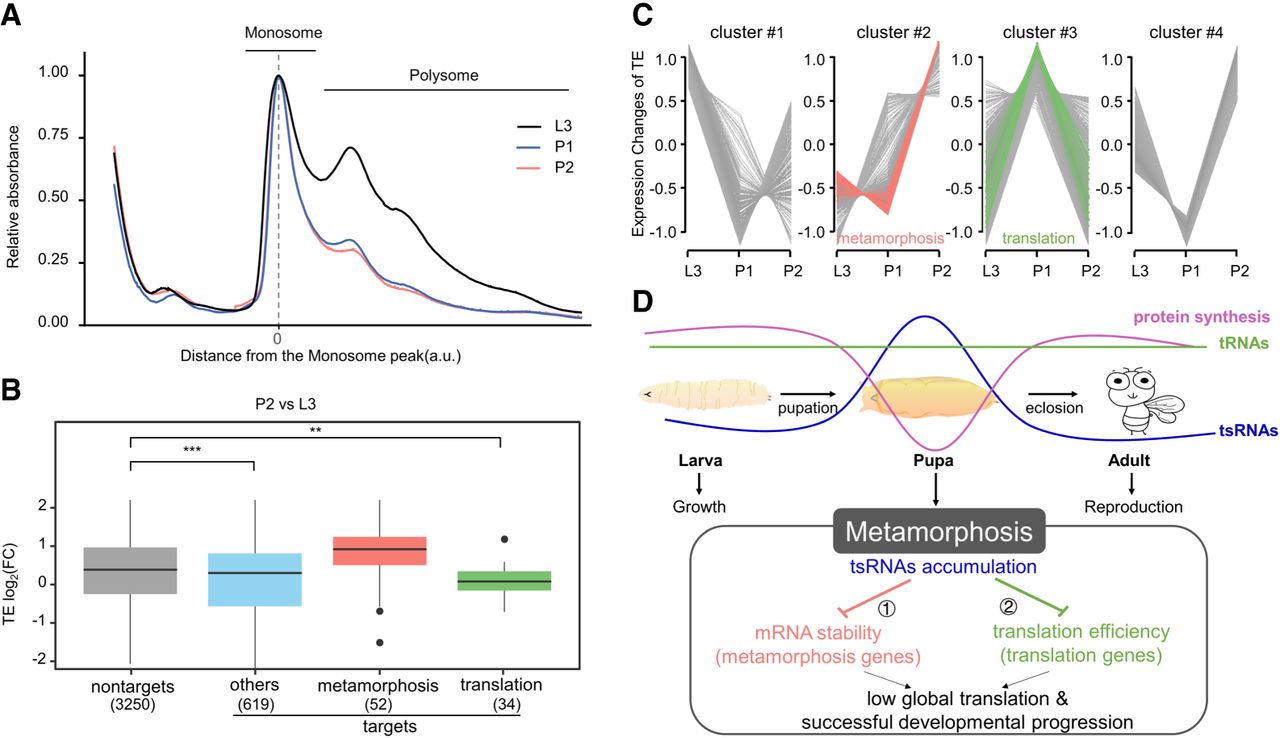
Genes in the translation group that are predicted targets of pupa-accumulated tsRNAs show a reduction in translation efficiency during pupation. (A) Absorbance profiles at 254 nm of RNA samples from L3 (gray), P1 (blue), and P2 (green). For each experiment, both the absorbance and the position were normalized to the 80S monosome peak. (B) Shown are the fold differences between P2 and L3 in TE of putative tsRNA target genes in different functional categories. Protein-coding genes that had mRNA-seq FPKM > 10 in both L3 and P2 were included. (C) Clustering of the time-series TE profiles from L3 to P2. A total of 3380 genes (mRNA-seq FPKM > 5) with TE that differed by at least twofold either between L3 and P1 or between P1 and P2 were used in the analysis. Hypergeometric test P = 10−4 and 10−6, for the metamorphosis group enrichment in cluster #2 (red) and the translation group enrichment in cluster #3 (green), respectively. (D) A graphic illustration of tsRNA regulatory activities during the larva-to-pupa transition of Drosophila. Despite the stable level of tRNAs (green), this transition is marked with an accumulation of tsRNAs (blue) and a decline of overall protein synthesis (purple), providing a special developmental context for understanding of tsRNA action. In a target site-dependent manner, the early pupa-accumulated tsRNAs specifically down-regulate gene expression in the metamorphosis group at the mRNA level (suppression arrow 1) and genes in the translation group at the translation level (suppression arrow 2). Subsequently, the global translation activity is reduced. Under this framework, the accumulation of functionally active tsRNAs instruct Drosophila metamorphosis to proceed through the larva-to-pupa-to-adult transition.



