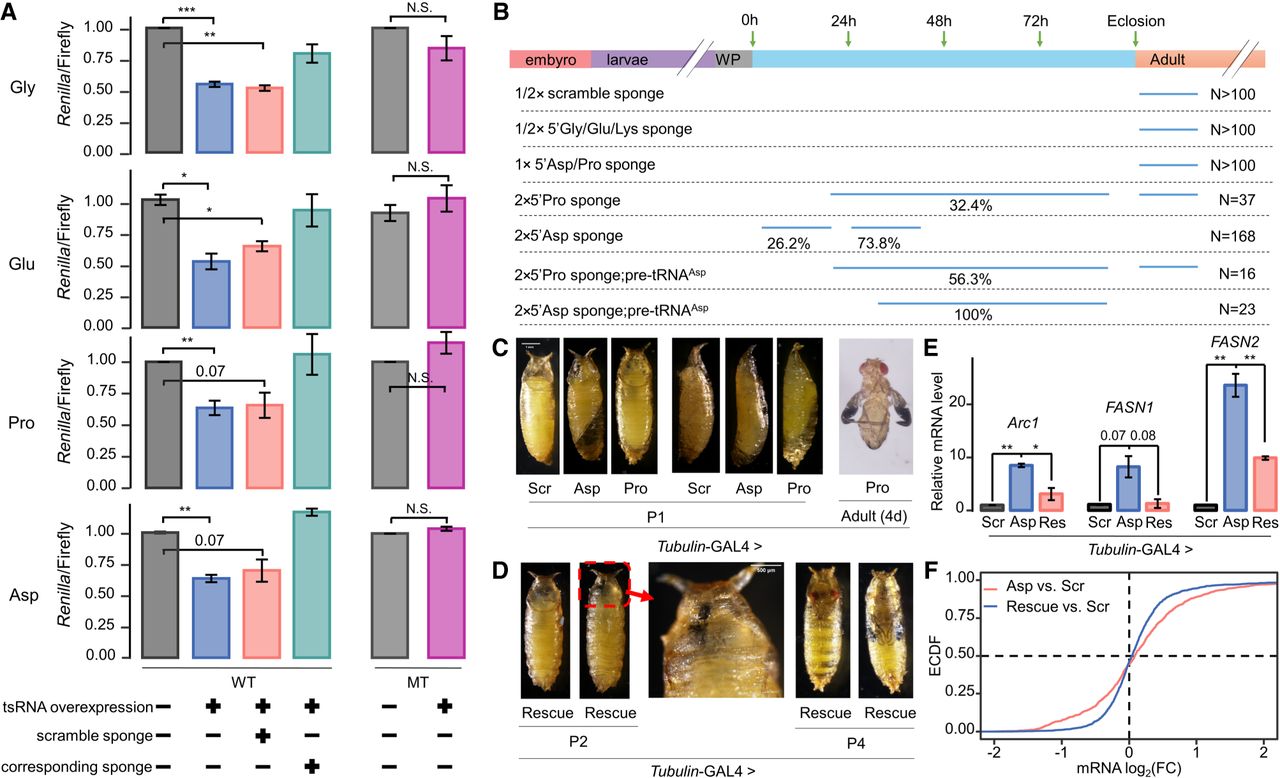
Evaluation of regulatory activities of 5′-tsRNAs in vitro and during development. (A) Normalized Renilla/Firefly reporter activities to assay target site-dependent regulation by 5′-tsRNAs. WT: Renilla reporter gene carrying three target sites of each tsRNA. The sequences were cloned from native genes carrying predicted target sites (Supplemental Fig. S9B). MT: Renilla reporter gene carrying three sites with scrambled sequences in the seed match. For 5′-tsRNAGlyGCC, 5′-tsRNAGluCUC, and 5′-tsRNAProUGG, the sites were placed in 3′ UTR; for 5′-tsRNAAspGUC, the sites were placed in CDS with the consideration of their higher inhibitory effects (Supplemental Fig. S7C). tsRNA overexpression: synthetic tsRNA mimic and the pAWH vector to express the corresponding pre-tRNA. tsRNA sponge: synthetic RNA sequence that is reversely complementary to the tsRNA. Scramble sponge: synthetic RNA sequence that is randomly scrambled from the sponge. See Supplemental Tables S2–S5 for the sequences. (B) Summary of the estimated lethality time based on the stage at which pupae stopped developing. For 5′-tsRNAGlyGCC, 5′-tsRNAGluCUC, 5′-tsRNALysUUU, and the scramble 5′-tsRNAAspGUC, Tubulin-GAL4-driven one or two copies of sponge elements did not show any observable phenotypes (N > 100). For Tubulin-GAL4-driven one copy of sponge element against 5′-tsRNAAspGUC and 5′-tsRNAProUGG, some mild traits were observed but all pupae emerged (N > 100). (C) The pupal lethality phenotype of Tubulin-GAL4-driven two copies of sponge elements against 5′-tsRNAAspGUC and 5′-tsRNAProUGG. All 5′-tsRNAAspGUC-sponge pupae (“Asp”; N = 168) did not survive beyond P2. 26.2% of them had an abnormal body curvature and died during P1. 73.8% showed a failure in head inversion and an improper air bubble location during P2. The 5′-tsRNAProUGG-sponge pupae (“Pro”; N = 37) showed high phenotypic heterogeneity. 32.4% of them proceeded through P1 but failed to eclose. 67.6% emerged with various defects such as un-spread wings 4 d after emergence. The Tubulin-GAL4-driven two copies of scramble sponge (“Scr”) was used as control, and all tested pupae (N > 100) emerged without observable defects. (D) Phenotypic rescue with pre-tRNAAspGUC. All rescued pupae (“Rescue”; N = 23) proceeded through P1 with finished head evert process and correct air bubble location. 43.5% of them lived to P4 as late pharate adults, but had leg malformation and did not eclose. (E) qRT-PCR confirming that the mRNA levels of three selected 5′-tsRNAAspGUC target genes were restored by pre-tRNAAspGUC. All samples were collected from P1 pupae. Arc1, FASN1, and FASN2 were selected because of their known expression and function during the larva-to-pupa transition. rp49 was used as internal control. Each experiment had two independent replicates. Error bars represent SEM, and Student's t-tests were used. (F) mRNA-seq confirming that the mRNA levels of 5′-tsRNAAspGUC target genes (N = 1411) were restored by pre-tRNAAspGUC. Kolmogorov–Smirnov test P-value = 10−11.