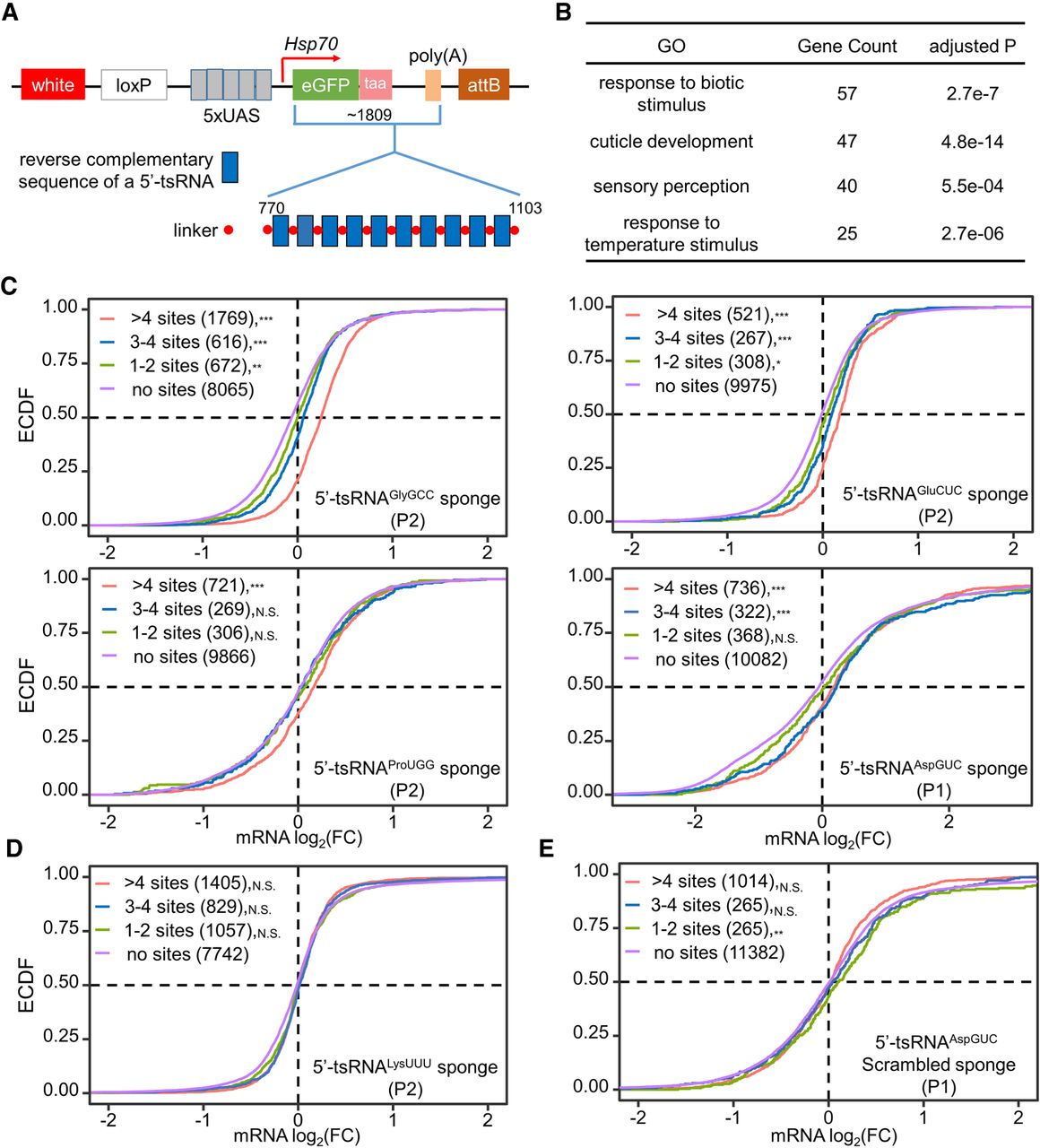
Ubiquitous delivery of tsRNA sponges increases the levels of mRNAs with antisense target sites in early Drosophila pupae. (A) Construction of tsRNA sponges. The sponge element consists of 10 repetitive sequences (blue) that are complementary to a tsRNA of interest. It was placed within the 3′ UTR of eGFP under the control of five UAS sites in an attB vector. Six sponge elements were generated against, respectively, 5′-tsRNAGlyGCC, 5′-tsRNAGluCUC, 5′-tsRNAProUGG, 5′-tsRNAAspGUC, 5′-tsRNALysUUU, and a scrambled 5′-tsRNAAspGUC sequence. The expected sizes of the entire transcript and the sponge element for different tsRNA sponges are similar, and shown here are the numbers for 5′-tsRNAAspGUC. The transgenes were integrated into either attP40 (on second chromosome) or attP2 (on third chromosome) site via the phiC31 system. (B) Gene Ontology (GO) annotation reveals the enriched functional categories of 1097 genes with significantly higher mRNA expression (log2(fold change) > 1 and adjusted P < 0.05) in the five Tubulin-GAL4-driven sponge lines than in w1118. (C–E) ECDF plot of the fold differences in mRNA levels between each Tubulin-GAL4-driven sponge line and w1118 (DESeq2-calculated baseMean > 50). For 5′-tsRNAGlyGCC, 5′-tsRNAGluCUC, 5′-tsRNAProUGG, 5′-tsRNALysUUU (D) and their control, samples were collected from P2 stage. For 5′-tsRNAAspGUC (C), the 5′-tsRNAAspGUC scramble (E) and their control, samples were collected from P1 stage. Purple: genes without any predicted target sites; green: genes with 1–2 sites; blue: genes with 3–4 sites; red: genes with >4 sites.