


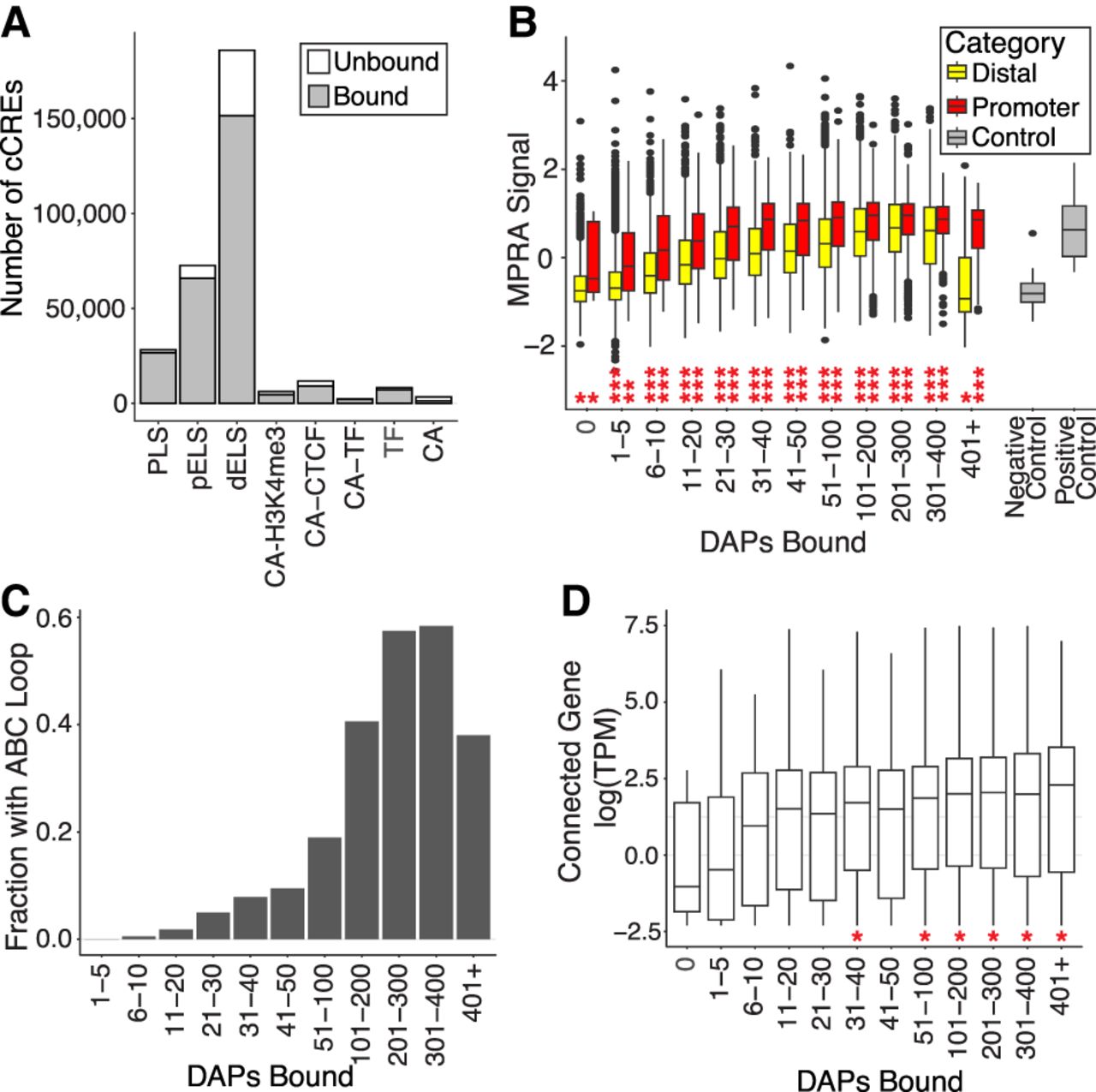
Genomic properties and activities of DAP-bound regions in genomic and reporter contexts. (A) The majority of cCREs of each type are bound by an assayed DAP. Bars show the number of sites of each cCRE class (x-axis) with at least one DAP association (“bound”) and those with none in our data set (“unbound”) when restricted to those overlapping with an ATAC-seq peak in HepG2. (PLS) Promoter-like signature, (pELS) proximal enhancer-like signature, (dELS) distal enhancer-like signature, (CA-H3K4me3) chromatin-accessible H3K4me3 region, (CA-CTCF) chromatin-accessible CTCF-bound region, (CA-TF) chromatin-accessible TF-bound region, (TF) TF-bound region lacking chromatin accessibility, and (CA) chromatin accessibility only. (B) Promoter elements from locally performed lentiMPRA experiments require fewer DAPs binding for high activity in lentiMPRA than do distal elements. Boxes show MPRA signal (natural log of normalized RNA reads over normalized DNA reads) of promoter elements as a function of binned number of DAPs (x-axis) with a peak in the genomic region. Promoters are defined as elements whose bounds overlapped with a 200-bp region centered on GENCODE TSSs. Distal elements are defined as elements at least 5 kb from annotated TSSs. Positive and negative control elements are plotted for comparison. In B and D, boxes represent 25%–75% quartiles with lines indicating the median, whiskers extend to ±1.5 × IQR (interquartile range) past the boxes, and when present, points are observations falling outside of this range. Unpaired t-tests were used to identify significant differences in the means between distal and promoter element activity in each category. (*) P = 0.05, (**) P = 0.0001, (***) P ≤ 2.2 × 10⁻¹⁶. (C) The fraction of distal loci with an ABC connection as a function of binned number of DAPs at a distal element. (D) Expression of genes genome-wide increases as the number of factors bound and connected distal elements increases. The y-axis indicates the natural log expression distribution of the ABC-supported gene as a function of binned number of DAPs at a distal element. Unpaired t-tests were used to identify significant differences in the means between the expression of a given category compared with expression in the zero category. (*) P = 0.05.



