


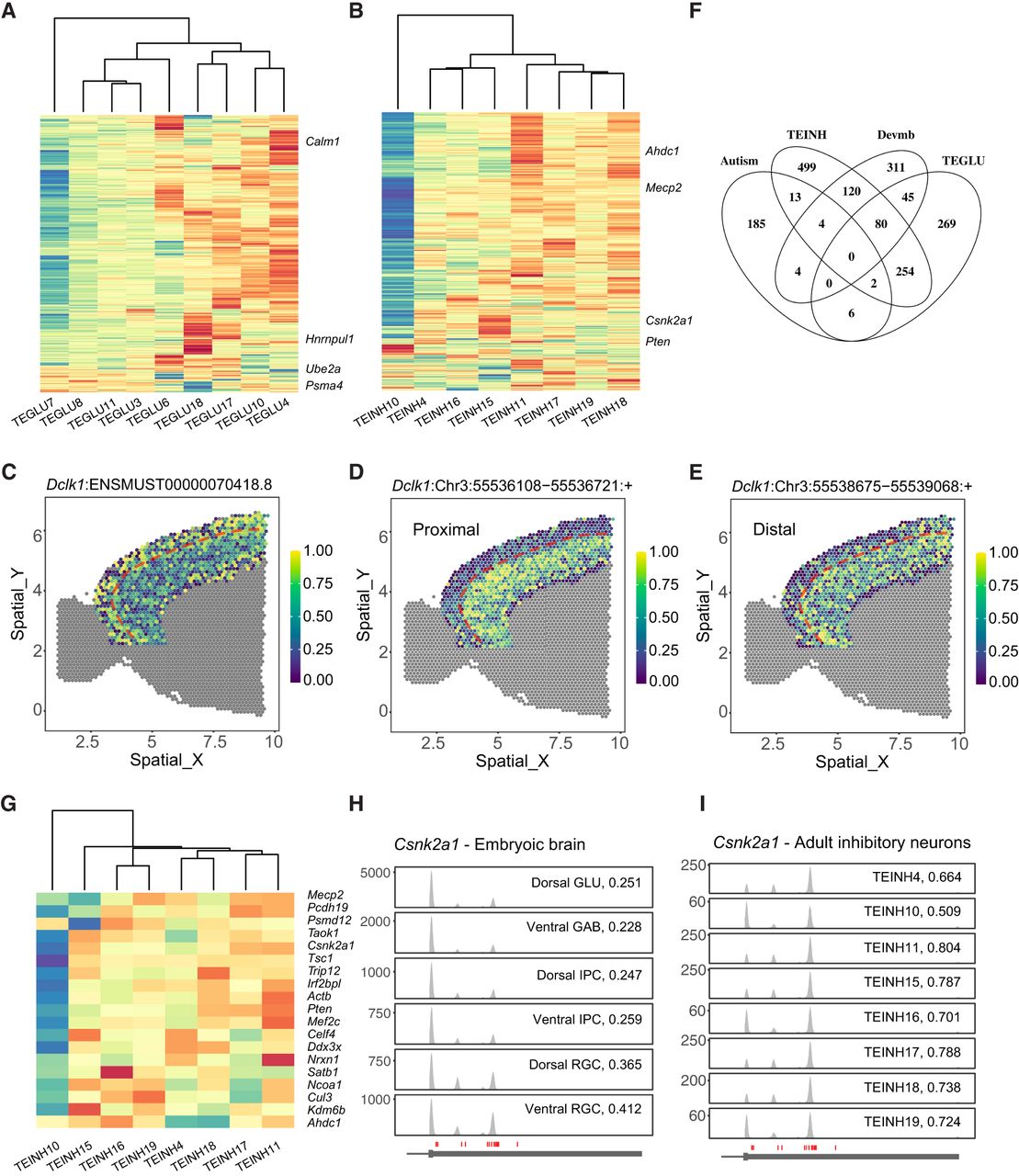
Cell type–specific PAs in the mouse brain. (A) Heat map showing cluster-level WARM values for significant differential PA transcripts among main telencephalon glutamatergic neuron clusters (TEGLU) (see also Supplemental Tables S15, S18). (B) Heat map showing cluster-level WARM values for significant differential PA transcripts among main telencephalon inhibitory neuron clusters (TEINH) (see also Supplemental Tables S16, S18). (C–E) APA patterns of transcript Dclk1:ENSMUST00000070418.8 in cortical layers. (C) WARM values per spot. (D,E) Relative expression of two peaks on this transcript, respectively. The dashed reference line indicates the boundary between layers II/III and IV. (F) Venn diagram for the following four gene lists: (1) SFARI autism-associated genes, (2) differential PA genes among TEINH, (3) differential PA genes among TEGLU, and (4) differential PA genes among developing mouse brain trajectories in the developing mouse brain data in Figure 4D. (G) Heat map showing cluster-level WARM values for the overlaps between autism-associated genes and significant differential PA genes among TEINH. (H) Coverage plot for Csnk2a1 across cell types in the developing mouse brain. (I) Coverage plot for Csnk2a1 across main adult TEINH.



