


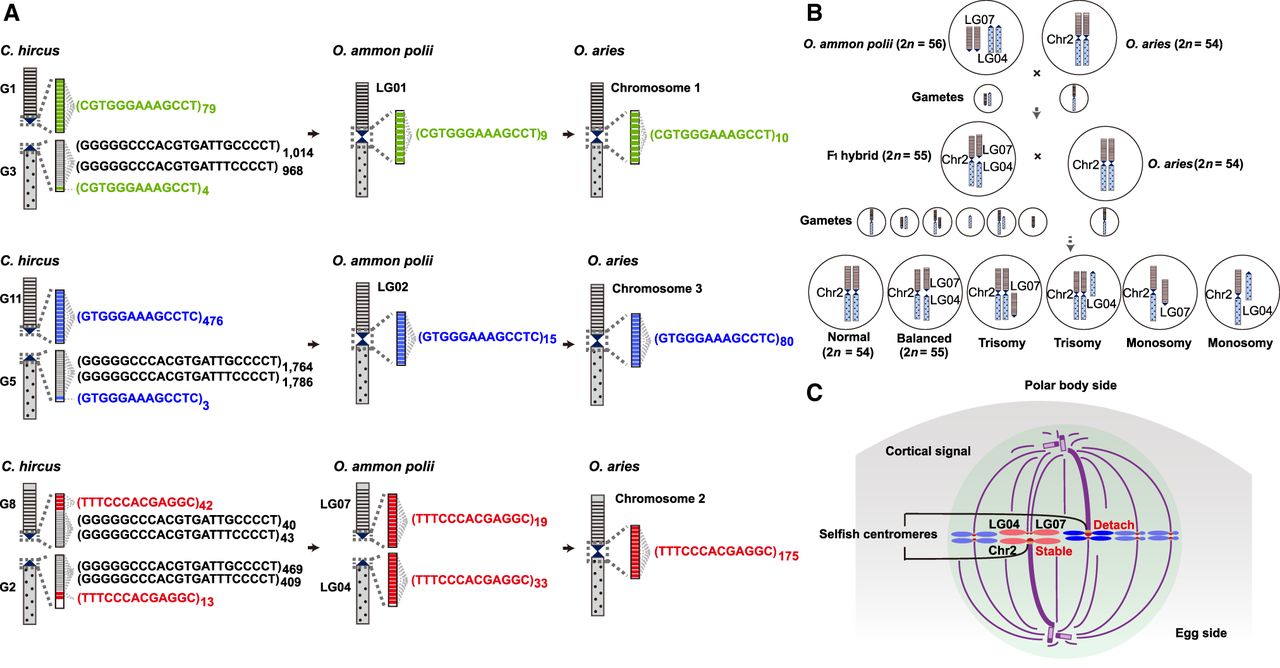
Evolution of three metacentric chromosomes of domestic sheep and the proposed molecular basis of fertility for the F1-hybrid. (A) Repeated sequences surrounding the breakpoints on the chromosomes involved in chromosome fusions in goat (C. hircus), argali (O. ammon polii), and domestic sheep (O. aries). (B) Schematic representation of chromosomal segregation and pairing (metacentric Chromosome 2 of domestic sheep and two acrocentric pseudochromosomes LG04 and LG07 from argali) during hybridization between argali (O. ammon polii) and domestic sheep (O. aries). Six different types of zygotes can be produced by the F1-hybrid, giving only one normal and one balanced embryo after fertilization with domestic sheep. (C) Proposed molecular mechanisms underlying the preference of F1-hybrid oocytes to generate gametes with 27 chromosomes rather than 28 chromosomes. That is, selfish centromeres (red/yellow circles) prefer the egg side when attached to the metaphase I spindle (purple) (Nikalayevich and Verlhac 2021). Chromosomes are in blue/pink, oocyte cytoplasm is in gray, and the zone of cortical proximity is in darker gray.



