


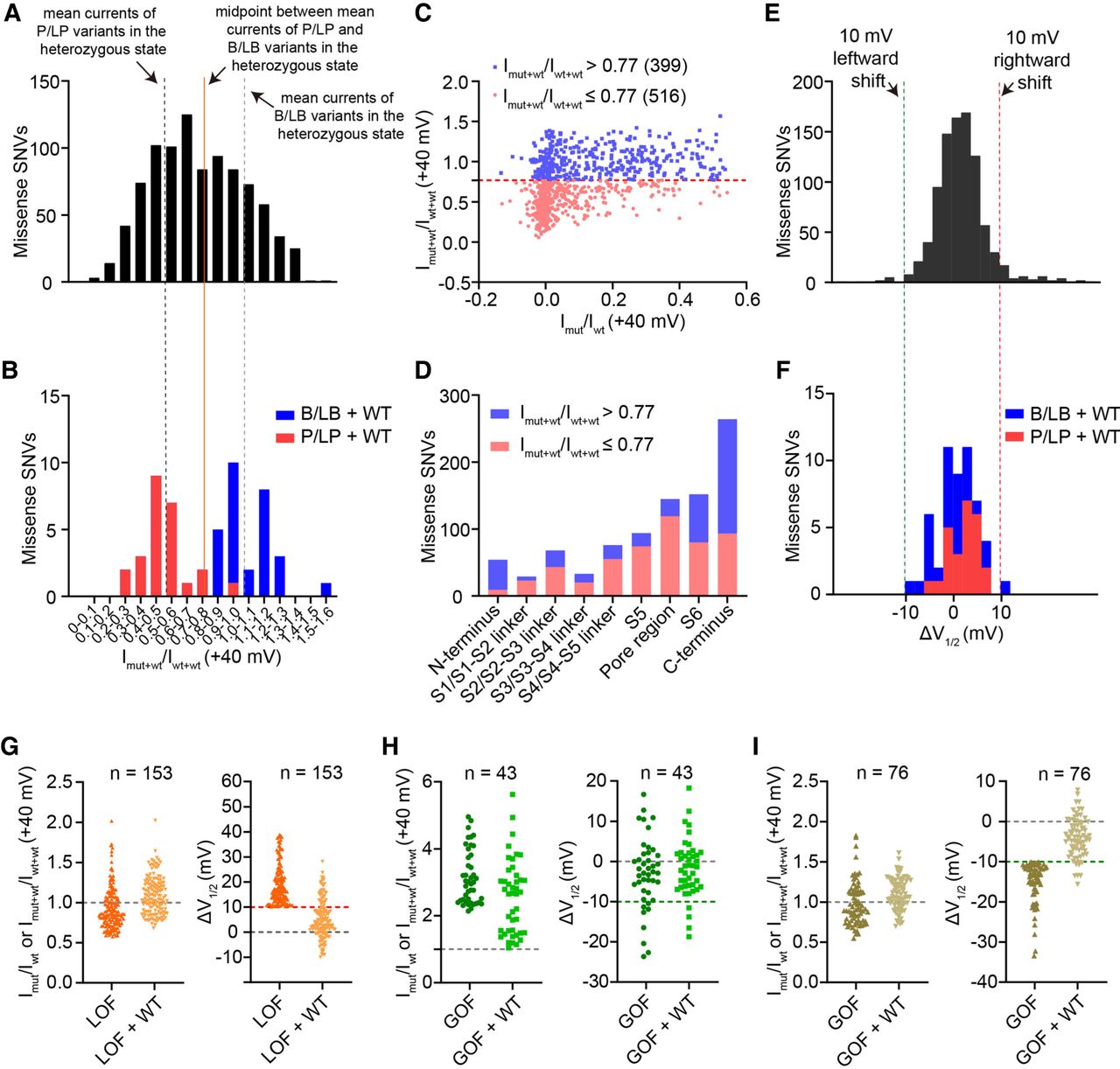
Functional properties of loss-of-function and gain-of-function variants in the heterozygous state. (A) The distribution of the normalized peak currents in the heterozygous state of 915 current-reduced variants. The black dashed line indicates the mean currents of known pathogenic/likely pathogenic variants in the heterozygous state, and gray indicates the mean currents of known benign/likely benign variants in the heterozygous state. The red solid line indicates the midpoint between the mean currents of known pathogenic/likely pathogenic and known benign/likely benign variants in the heterozygous state. (B) The distribution of the normalized peak currents in the heterozygous state of 25 known pathogenic/likely pathogenic and 28 known benign/likely benign variants. (P) Pathogenic, (LP) likely pathogenic, (B) benign, and (LB) likely benign. (C) Plots for comparing normalized currents of expressing 915 current-reduced variants alone and coexpressing with WT. The red dashed line indicates 0.77 of the WT value. There are 516/915 variants with normalized peak currents ≤ 0.77 and 399/915 variants with normalized peak currents > 0.77 in the heterozygous state. (D) The number of variants with normal or impaired currents in the heterozygous state in each domain. (E) The distribution of V1/2 obtained from 915 current-reduced variants in the heterozygous state. (F) The distribution of V1/2 obtained from 25 known pathogenic/likely pathogenic and 28 known benign/likely benign variants in the heterozygous state. (G) Normalized peak currents (left) or V1/2 activation (right) for expressing 153 loss-of-function variants (normal currents and large rightward shifts in V1/2 when expressed alone) versus coexpressing with WT. (H) Normalized peak currents or V1/2 activation for expressing 43 current-enhanced variants versus coexpressing with WT. (I) Normalized peak currents or V1/2 activation for expressing 76 gain-of-function variants (normal currents and large leftward shifts in V1/2 when expressed alone) versus coexpressing with WT.



