


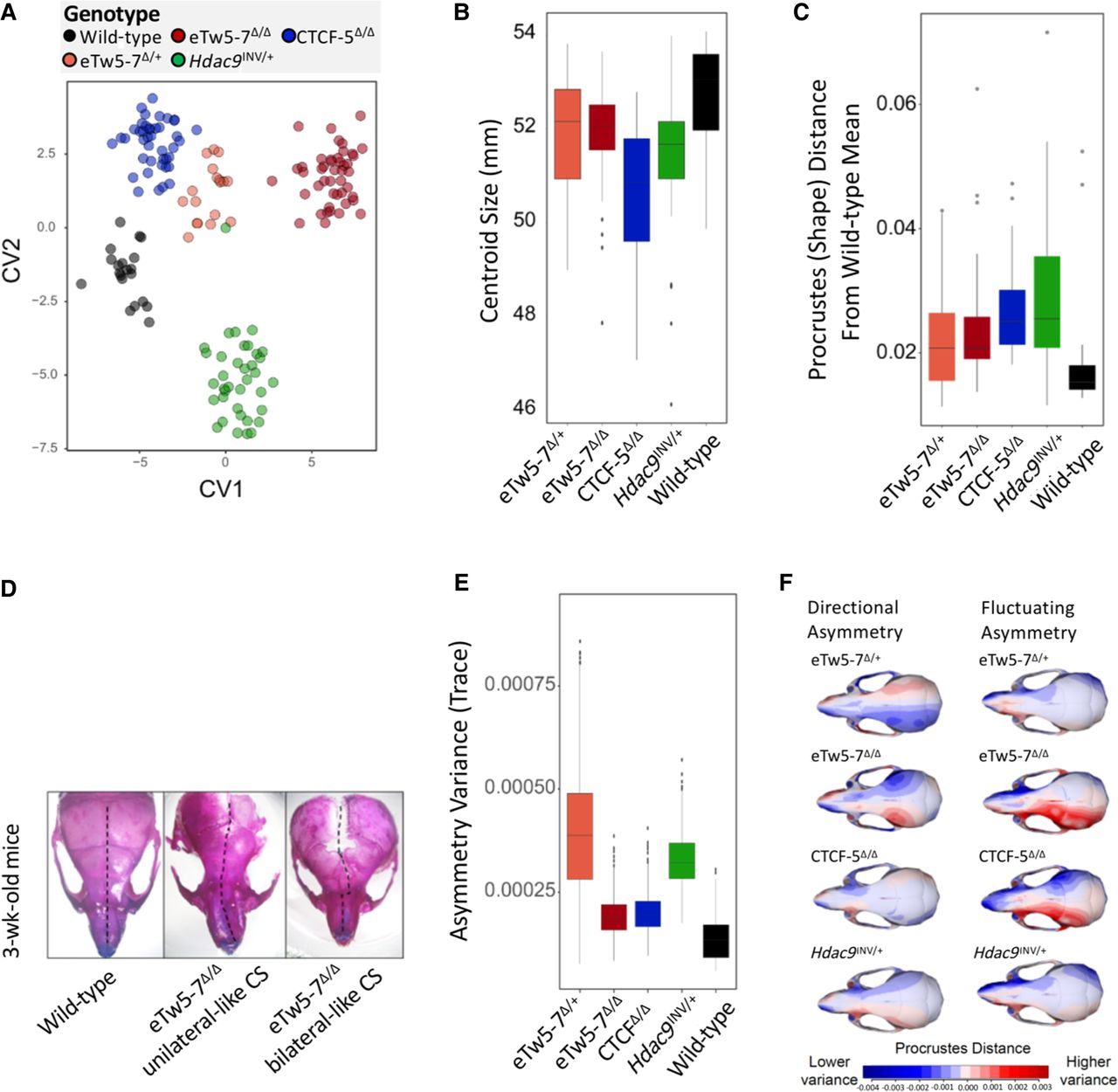
Deletions of Twist1 regulatory elements lead to craniosynostosis-like morphology. (A) Canonical variate analysis (CVA) of micro-CT data from eTw5-7Δ/Δ, eTw5-7Δ/+, CTCF-5Δ/Δ, and Hdac9INV/+ mice compared to wild type. (B) Cranial size by genotype. (C) Box plot for procrustes (shape) distances for each individual from the wild-type mean shape. Note that because the procrustes distance is unsigned, the average and minimum procrustes distance for the wild type is positive and not 0. (D) Representative pictures of stained skulls of 3-wk-old wild-type and eTw5-7Δ/Δ mice, showing a range of variation in skull morphology. The dashed black line represents the asymmetric structure with unilateral (middle) and bilateral (right) craniosynostosis-like phenotypes. (E) Box plot of the asymmetry variance differences among the different genotypes and the wild type. It depicts group differences in the amount of variance explained by the asymmetric component of shape variation of the skull. (F) Heat map visualizations for each asymmetry component (directional asymmetry and fluctuating asymmetry), displaying the patterns of shape variation in each genotype compared to the wild type.


