


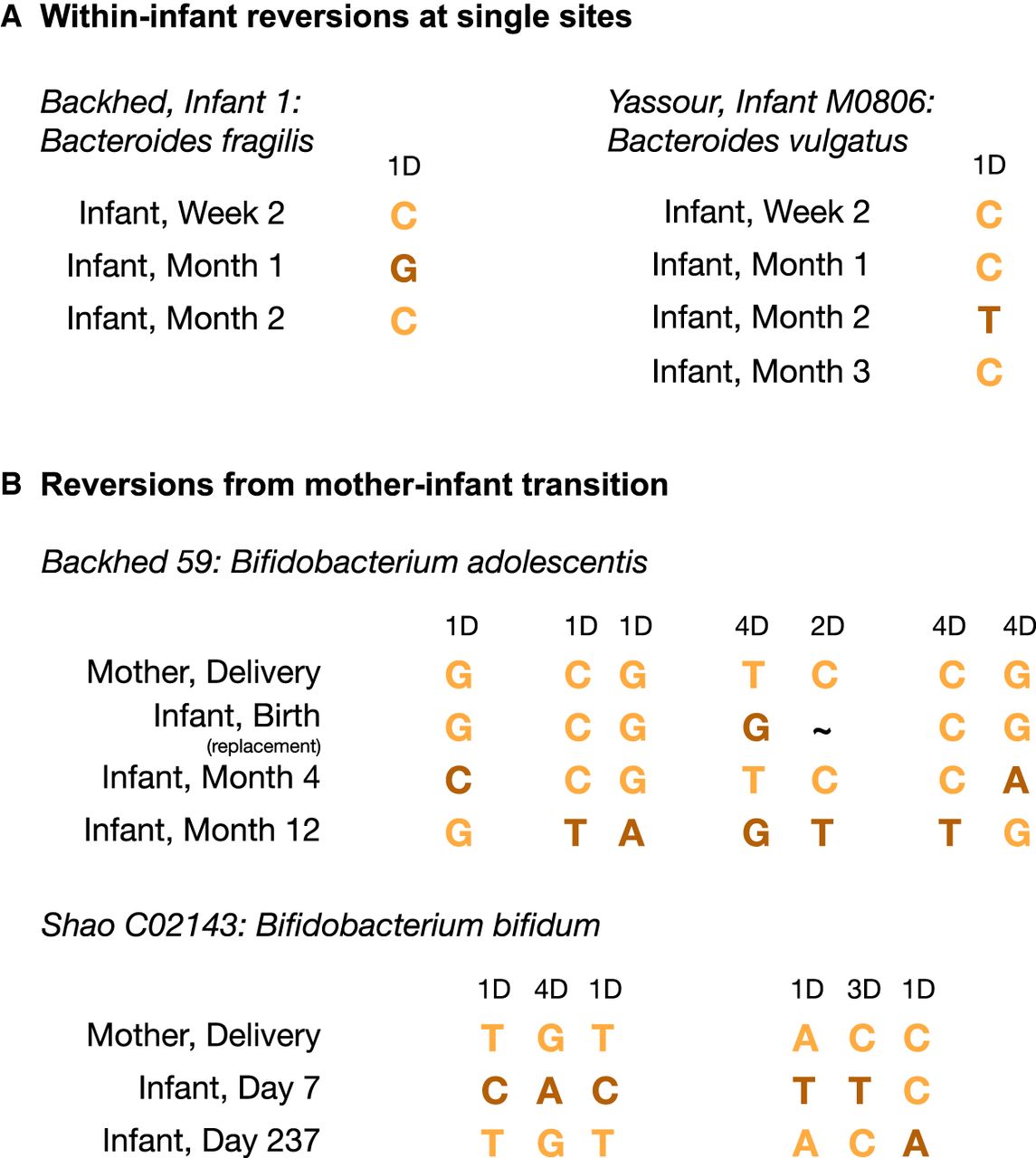
Reversion events in infant gut microbiomes. There were 371 host × species instances with at least three QP samples across available infant time points and mother at delivery. Of these, 13 experienced modifications at two nonoverlapping time point pairs. Seven of these 13 experienced reversions; here, we illustrate the haplotypes corresponding to these reversions. Sites are ordered by gene's position in the reference genome. Sites are annotated as being in a 1D, 2D, 3D, or 4D position, which indicates codon degeneracy. For example, 1D indicates that the site is onefold degenerate (any nucleotide difference results in an amino acid change), whereas 4D indicates that the site is fourfold degenerate (any nucleotide difference will not result in an amino acid change). 2D and 3D sites indicate that either two or three possible nucleotide changes, respectively, can be tolerated before the amino acid is changed. (A) In five of these cases, there is a reversion at a single nonsynonymous site to an allelic state that is prevalent in adults; two examples are shown. (B) In two instances, multiple nucleotides change at both synonymous and nonsynonymous sites. In the host “Backhed 59,” a replacement occurs at birth with respect to mother, and then by month 4, it reverts back to the strain harbored by mother.



