


C. Thomas Caskey (1938–2022)
- Richard A. Gibbs1,
- Aravinda Chakravarti2,
- Evan E. Eichler3,
- Eric D. Green4,
- Richard M. Myers5,
- Anne C. Ferguson-Smith6,
- Kateryna D. Makova7 and
- Hillary E. Sussman8
- 1Human Genome Sequencing Center, Baylor College of Medicine, Houston, TX; Department of Molecular and Human Genetics, Baylor College of Medicine, Houston, TX;
- 2Center for Human Genetics and Genomics, New York University Grossman School of Medicine, New York, NY; Department of Neuroscience and Physiology, New York University Grossman School of Medicine, New York, NY;
- 3Department of Genome Sciences, University of Washington School of Medicine, Seattle, WA; Howard Hughes Medical Institute, University of Washington, Seattle, WA;
- 4National Human Genome Research Institute, National Institutes of Health, Bethesda, MD;
- 5HudsonAlpha Institute for Biotechnology, Huntsville, AL;
- 6Department of Genetics, University of Cambridge, Cambridge, UK;
- 7Department of Biology, Penn State University, University Park, PA; Center for Medical Genomics, Penn State University, University Park and Hershey, PA;
- 8Genome Research, Cold Spring Harbor Laboratory Press, Cold Spring Harbor, NY
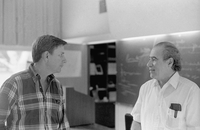
Tom Caskey (left) and Norton Zinder (right) in November 1989 at the Banbury Meeting, “The Human Genome Project: NIH-DOE joint meeting.” (Image courtesy of Cold Spring Harbor Laboratory Archives.)
A pioneer of the genetic code and then genomics, Dr. C. Thomas Caskey, passed away at the age of 83 on January 13, 2022 in Houston, Texas, after a brief illness. He is survived by his wife of 62 years, Peggy Pearce Caskey, his two children, Clifton Caskey and Caroline Caskey Goodner, and three grandchildren. He will be sorely missed by them and his many trainees and colleagues around the world.
The breadth of Tom's contributions to the fields of human molecular genetics and genomics during his approximately 60-year career is extraordinary. He can be credited for: contributing key work to decipher the genetic code (Caskey 1970); cloning the third human gene to be so analyzed (Brennand et al. 1982, 1983); discovering short tandem repeat expansions in human disease (Caskey et al. 1992); building a robust and ubiquitously used DNA-based human identification system (Edwards et al. 1991); founding and leading an internationally acclaimed academic department focused on molecular and human genetics; leading a division at Merck Research Laboratories in drug and vaccine development; and advancing genomic medicine in the clinic. Throughout all these endeavors, he was tremendously active in the community, both at the policy level and as an inspirational and collaborative scientist. He trained and mentored an enormous number of individuals, making an indelible impression on more than one generation of scientists. His influence was pronounced in academics, industry, and even outside the world of science.
Other articles paying tribute to Tom will surely celebrate his career achievements, describe his deep passion for competitive ocean sailing, and elaborate on his multitude of trainees that now populate the research enterprise. Within the scope of Genome Research, it is particularly appropriate to note his foundational work in genomics and his impact on both genomics and genetics as the fields co-evolved.
Tom trained as an M.D., then worked with Marshall Nirenberg at the U.S. National Institutes of Health (NIH) on deciphering the genetic code (Marshall et al. 1967) and, with his colleague Ed Scolnick, on the role of release factors in peptide chain termination (Scolnick and Caskey 1969). He moved to Baylor College of Medicine in 1971 to explore the molecular bases of Mendelian diseases. For much of his ensuing career, Tom studied the molecular genetics of Lesch-Nyhan syndrome and the underlying gene, hypoxanthine phosphoribosyltransferase (HPRT1, previously known as HPRT), co-authoring more than 60 related publications. In 1982, he undertook a sabbatical with Sydney Brenner at the Laboratory of Molecular Biology, Cambridge, UK, with the specific aim of learning the molecular cloning techniques that would enable him to isolate the HPRT cDNA (Brennand et al. 1982). The momentum from this work consolidated his commitment to advancing genetics by focusing on technology development and application.
In 1984, he founded the “Institute for Molecular Genetics” (later becoming the Department of Human and Molecular Genetics) at Baylor College of Medicine and soon recruited faculty, fellows, and clinicians, who together brought expertise that ranged from the basic sciences to clinical genetics. Through the work in his own laboratory, and his presence and influence in the clinic, he led the entire Institute in exploring the molecular causes of genetic diseases and building models that could be used for experimentation and therapeutic development. His leadership included the recruitment of model organism geneticists, based on his strong belief that studies in these models would provide insights that could translate to medical research and practice.
Tom attended the earliest meetings on the conceptualization of the Human Genome Project, including the gathering at Alta (1984), the 1986 Cold Spring Harbor Symposium “The Molecular Biology of Homo Sapiens,” and the 1989 NIH and Department of Energy–supported Banbury Center meeting, at which plans to generate a genome-wide physical map were discussed (Cook-Deegan 1991). He embraced new methods to speed disease gene discovery and molecular diagnostics in his newly formed “Baylor Diagnostic Laboratories.” Meanwhile, he enabled the faculty to build programs in molecular cloning with novel vectors (e.g., cosmids and yeast artificial chromosomes), linkage mapping, and DNA sequencing. He was an early and passionate enthusiast for genome sequencing. In 1987, after reading about Yuji Kohara's physical map of the E. coli genome (Kohara et al. 1987) based on bacteriophage clones, he immediately proposed the idea of pursuing a similar effort for the human X Chromosome. Shortly thereafter, following a visit to the laboratory of Craig Venter, he widely extolled the value of a full human genome sequence. He led by example and, in 1988, began a collaboration with Wilhelm Ansorge at the EMBL laboratories to sequence the entire human HPRT locus (∼44 kb) using the Pharmacia ELF Fluorescent DNA sequencing instrument. The results of this collaboration were reported the same year as the launch of the Human Genome Project (Edwards et al. 1990) and embodied all of the methods that were later used for generating the first sequence of the human genome.
After 1990, Tom continued to pursue and champion the goals of the Human Genome Project, emphasizing the importance of “early wins” through disease gene discovery. His work included the identification of the role of triplet repeats in Fragile X syndrome in 1991 (Pieretti et al. 1991) and subsequent discoveries about the role of short tandem repeats in other disorders (Caskey et al. 1992). Tom also recognized the power of short tandem repeats for human identification and collaborated with scientists from the Federal Bureau of Investigation (FBI) to build the system now known as the Combined DNA Index System (CODIS) (Baechtel et al. 1991) for forensic identification using multiplex PCR.
Throughout this period, Tom energetically pursued the forefront of genomics. In 1992, he expanded his vision and emphatically argued for the importance of characterizing the genetic basis of human disease within the research portfolio of the National Human Genome Research Institute, in parallel with their support of the Human Genome Project. Competing opportunities led him to leave Houston in 1994 to direct a division at Merck Research Laboratories focused on the development of drugs and vaccines. He maintained that post until returning to Houston and eventually joining the Human Genome Sequencing Center that he had inspired two decades earlier.
As an internationalist, Tom both encouraged engagement with scientists of other nations and promoted projects that would build bridges with the USA. He worked closely with Genome Canada and other Canadian agencies to advance genomics. At the same time, in Texas, he spurred the governor toward early support for the Bovine Genome Project, which led to a collaboration between 25 different countries (Tellam et al. 2009).
At all times, Tom was an outstanding mentor and colleague. While he traveled relentlessly and communed with the highest levels of policy makers, he maintained his passionate connection with his trainees and colleagues, never failing to make provocative and imaginative suggestions as to how to advance their science. He built, and largely funded, an MD-PhD training program that has for decades attracted top-tier students. He and his family committed entirely to the vision of building strength in molecular genetics and genomics, hosting guests and events almost continually.
Tom received many awards and recognition, including election to the National Academies of Sciences and of Medicine. Recently, the American Society of Human Genetics recognized his lifelong contributions with the Allan Award. At Genome Research, we recognize the significance of his early contributions to genomics, including his trainees, and his commitment to demonstrating how new technologies, combined with strong scientific principles and a dedication to clinical care, can advance human well-being. Tom exemplified the true meanings of “leadership” and of “love of science and medicine” and remains an inspiration to genome scientists and beyond.
Acknowledgments
We thank Jan A. Witkowski and David L. Nelson for their valuable comments and suggestions.
Footnotes
-
Article published online before print. Article and publication date are at https://www.genome.org/cgi/doi/10.1101/gr.276658.122.
-
Freely available online through the Genome Research Open Access option.
This article, published in Genome Research, is available under a Creative Commons License (Attribution-NonCommercial 4.0 International), as described at http://creativecommons.org/licenses/by-nc/4.0/.



