


Deborah A. Nickerson (1954 –2021)
- Aravinda Chakravarti1,2,
- Evan E. Eichler3,4,
- Richard A. Gibbs5,6,
- Eric D. Green7,
- Richard M. Myers8 and
- Hillary E. Sussman9
- 1Center for Human Genetics and Genomics, New York University Grossman School of Medicine, New York, NY;
- 2Department of Neuroscience and Physiology, New York University Grossman School of Medicine, New York, NY
- 3Department of Genome Sciences, University of Washington School of Medicine, Seattle, WA;
- 4Howard Hughes Medical Institute, University of Washington, Seattle, WA
- 5Human Genome Sequencing Center, Baylor College of Medicine, Houston, TX;
- 6Department of Molecular and Human Genetics, Baylor College of Medicine, Houston, TX
- 7National Human Genome Research Institute, National Institutes of Health, Bethesda, MD
- 8HudsonAlpha Institute for Biotechnology, Huntsville, AL
- 9Genome Research, Cold Spring Harbor Laboratory Press, Cold Spring Harbor, NY
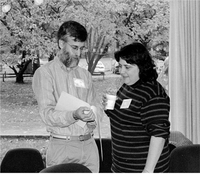
Debbie Nickerson and Andrew Clark in November 1998 at the Banbury Meeting, “Large-scale Discovery and Genetic Applications of SNPs,” organized by Aravinda Chakravarti and Eric Lander (Image courtesy of Cold Spring Harbor Laboratory Archives).
In what was already a difficult year, 2021 ended on a somber note with the untimely death of Debbie Nickerson, a highly accomplished genomics researcher, a role model professional, and a long-time friend of Genome Research.
Debbie Nickerson passed away at her home, surrounded by her family, on Christmas Eve, December 24, 2021. She was 67 years old and just days away from celebrating her 68th birthday. Her passing came as a shock to all who knew and loved her. As reactions to her death filled email inboxes and social media outlets, it became evident that the world had unexpectedly lost a true genomics icon.
Debbie was born in Mineola, New York, to Josephine and William Nickerson and as an adult expressed enduring pride for her New York roots. After earning her PhD from the University of Tennessee in 1978 and joining the faculty at the University of South Florida, she joined the laboratory of Leroy Hood at Caltech in 1989 and quickly grew fascinated with genomic technologies (Charmley et al. 1994). In 1992, she moved to Seattle to become a faculty member at the University of Washington in the Department of Molecular Biology and, in 2001, a founding member of the Department of Genome Sciences.
Debbie rapidly found her niche at the interface of developing and rapidly adopting new genomic technologies, with a particular focus on DNA sequencing methods that could be used to understand the natural pattern of human genomic variation and its impact on health and disease. Her research group made early contributions to pharmacogenomics, immunogenomics, and the use of genomics to study cardiovascular disease. This work included some of the first efforts to determine how patients’ genotypes could be used to optimize warfarin dosing (Rieder et al. 2005).
Debbie worked hard to make Seattle the site of one of the world's premier genome sequencing centers, founding and directing the Northwest Genomics Center (NWGC) in 2009 with major support from the National Institutes of Health (NIH). She frequently espoused her views about the power of high-throughput DNA sequencing for improving human health and was often heard saying “Just sequence it!” Debbie was a strong proponent of improving our understanding of human genomic diversity as a means to mitigate some of the inequities in genetic discoveries and diagnoses. For example, she used data from the exome sequencing of thousands of individuals to develop one of the first databases of normal human genomic variation, the Exome Variant Server, which paved the way to accelerating the discovery of thousands of disease-causing mutations associated with Mendelian disease, autism, and other genetic disorders (Exome Variant Server, NHLBI GO Exome Sequencing Project). Her research and the quality of the genomic data generated under her leadership were recognized both nationally and internationally. By 2021, Debbie's leadership had made the NWGC, which was focused on the genomics of rare Mendelian disorders (Bamshad et al. 2012), a core contributor to the Trans-Omics for Precision Medicine (TOPMed) program funded by the National Heart, Lung, and Blood Institute (Taliun et al. 2021), and a major producer of genome sequence data for the NIH All of Us Research Program.
While Debbie's name appears on more than 450 research publications, she was never one to seek the limelight with respect to authorship—or any type of accolade. She believed that the sequencing of human genomes was a group effort and found satisfaction in seeing the data generated under her stewardship lay a foundation for advancing human genetics. This community spirit led to Debbie's selfless work leading several policy and operational groups within large research consortia. She brought both passion and sensibility to those commitments and was consistently a voice of reason. At the end of a long day at a scientific meeting, gathering with Debbie to reflect on the state of the science and the community was always a highlight, and it was times like those where we were all made comfortable by her authenticity and unpretentiousness. Her friendship and broad-ranging insights will be sorely missed.
Debbie was the consummate mentor. Within the University of Washington's Department of Genome Sciences, she became the unofficial advisor to students, postdoctoral fellows, and junior faculty—regardless of the individual's research group affiliation. She never missed an opportunity to advise a junior researcher at any rank about the next step in their career path. Her style was often forceful and direct, pointing out areas where improvement was needed, but delivered in a fashion in which the recipient knew that she had their best interests at heart. She wrote countless letters of recommendation and used her connections (and persuasiveness!) to help many young scientists secure their first faculty positions. She was a shrewd negotiator when it came to reviewing offer letters of those under her mentorship, inevitably encouraging the individual to ask for more.
Debbie's transparency in advocacy and thought was unwavering. In an almost-unfiltered fashion, she spoke her mind about what was needed to advance science, to train the next generation of researchers, and to ensure fairness and equity in biomedicine. Her conviction and voice were the same whether she was speaking to local colleagues, peers in the research community, journal editors, or scientific leaders, including NIH institute directors. For the latter, she exemplified someone who was profoundly comfortable “speaking truth to power.” Her forceful nature was widely respected, mostly because she was almost always right in her views—in many cases speaking candidly about difficult topics and circumstances that, while uncomfortable to confront, were in need of greater attention and action. Importantly, Debbie's voice was the loudest and most sincere when it came to advocating for others, such as women and other underrepresented groups, believing that she and her peers had a responsibility to practice what they preached—by increasing diversity in both research participants and in the workplace. While her altruist passion was occasionally met with an alternative view(s), she was always admired for her thoughtfulness and candor.
Genomics is a new field, and all of its early practitioners, including us, did not train in “genomics.” We were all immigrants to this new science. The field has evolved only because our own research has evolved. Debbie's career shows how someone who did not even know of this field became a leading proponent. Traversing this unknown space required courage, because the potential scientific failures were many, and Debbie exemplified this courage more than others. Just days before her death, those who visited Debbie in the hospital's intensive care unit encountered a focused researcher who was still passionate about genomics research, concerned about the welfare of students, and immensely proud of her research team and their accomplishments. While there was much more that she had hoped to do, she expressed to family and friends that she “had led a great life.” Tenacious until the end, Debbie was a true original of genomics research, and we are all beneficiaries of her legacy.
Footnotes
-
Article published online before print. Article and publication date are at https://www.genome.org/cgi/doi/10.1101/gr.276582.122.
-
Freely available online through the Genome Research Open Access option.
This article, published in Genome Research, is available under a Creative Commons License (Attribution-NonCommercial 4.0 International), as described at http://creativecommons.org/licenses/by-nc/4.0/.


