


Cover image
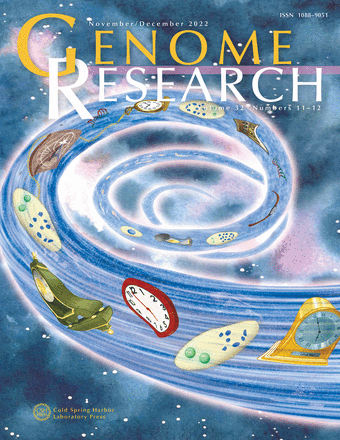
Transposable elements (TEs) have colonized the genome of most living species and represent a major threat to genome integrity. The ciliate Paramecium has evolved a mechanism for precise excision of thousands of TE-derived internal eliminated sequences (IESs) at each sexual cycle. IES excision follows a sequential order that reflects their evolutionary age. The most ancient IESs have evolved by optimizing their excision efficiency, acquiring strong sequence determinants and escaping epigenetic control. In this illustration, Paramecium cells are trapped in a vortex that depicts evolutionary time, while the timing of IES elimination is represented by the melting clocks inspired by Dali. (Cover artwork by Mickaël Bourge. [For details, see Zangarelli et al., pp. 2028–2042.])

