


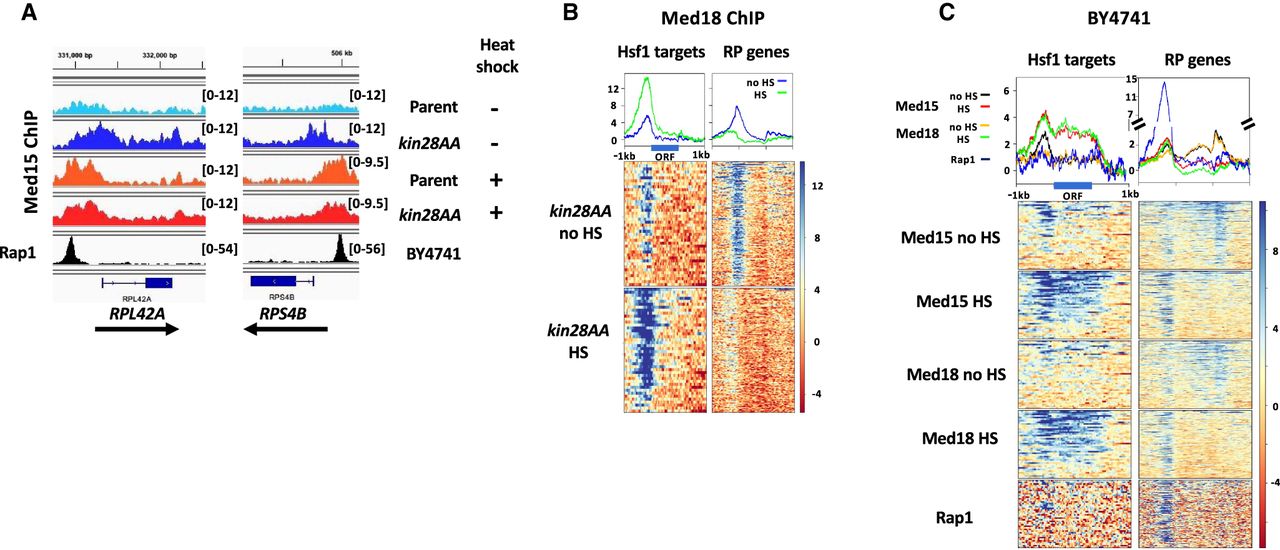
Mediator association persists at RP genes after heat shock. (A) Browser scans showing normalized occupancy of Med15 upstream of RPL42A and RPS4B in kin28AA yeast and the parent strain YFR1321, both treated with rapamycin, with and without heat shock (top four scans) or Rap1 in strain BY4741 (bottom scan). Scale, in reads per million mapped reads, is indicated for each scan. (B) Heat maps and line graphs depicting normalized occupancy of the Mediator head module subunit, Med18, in kin28AA yeast treated with rapamycin, with and without heat shock, at Hsf1 targets and RP genes. (C) Heat maps and line graphs depicting normalized occupancy of Mediator subunits Med15 (tail) and Med18 (head), and Rap1, at Hsf1 target genes and RP genes in BY4741. The signal observed at transcribed ORF regions (seen at Hsf1 targets under heat shock conditions, and at RP genes under non-heat-shocked conditions) is a ChIP artifact frequently observed at highly transcribed ORFs (Eyboulet et al. 2013; Park et al. 2013; Teytelman et al. 2013; Jeronimo and Robert 2014; Knoll et al. 2020).


