


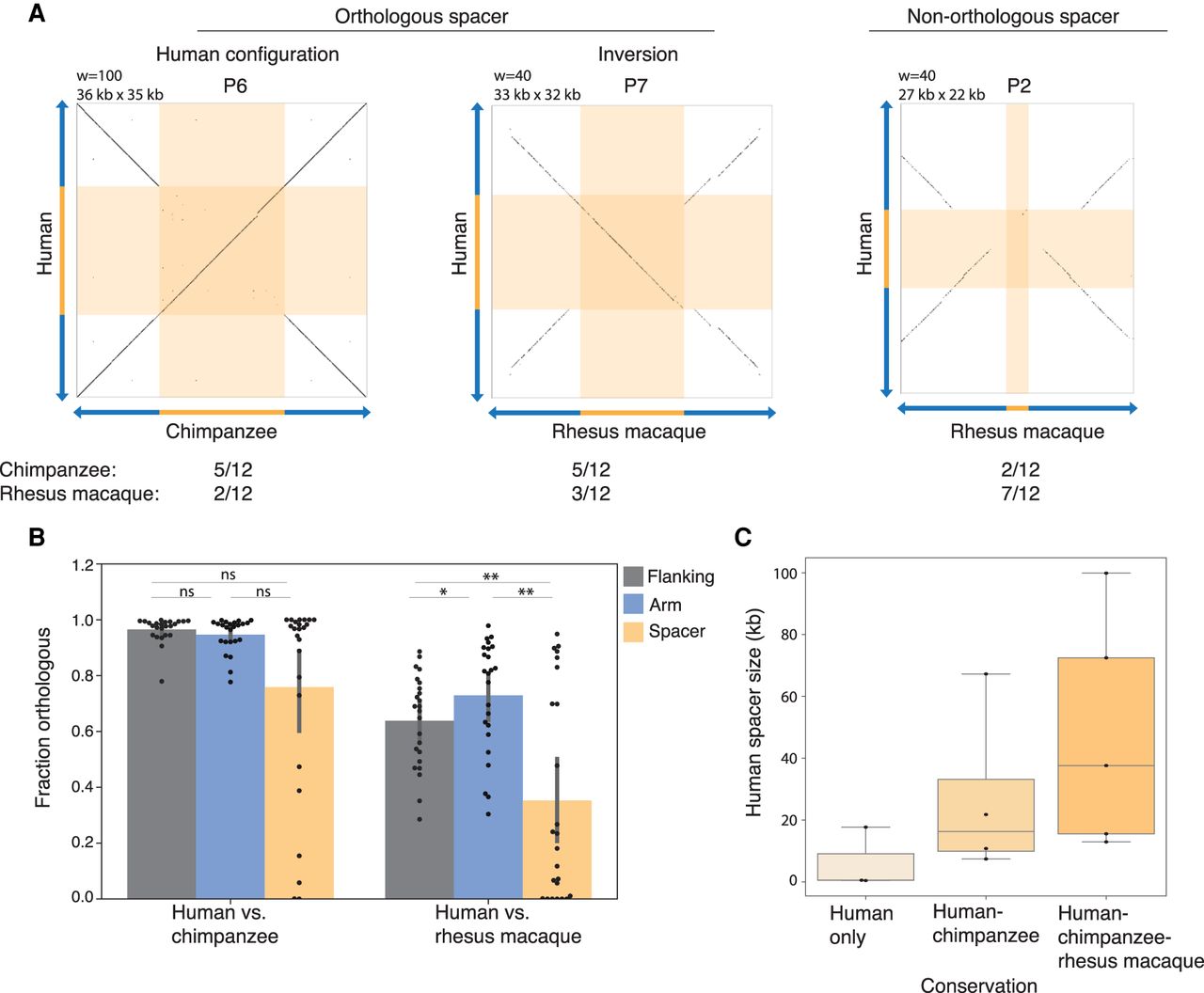
Structural changes between orthologous X-Chromosome palindromes are concentrated around the center of symmetry. (A) Square dot plots comparing the center of the palindrome, including the spacer and 10 kb of inner arm sequence on each side, between the indicated species. (Orthologous spacer) >20% of the spacer from one species aligned to the spacer from the other, in either the same orientation (“Human configuration”) or opposite orientation (“Inversion”); (Non-orthologous) <20% of the spacer from one species aligned to the spacer from the other. Values show the number of orthologous palindromes shared by human, chimpanzee, and macaque in each category. (B) Average fraction of sequence that could be aligned between species. (*) P < 0.05, (**) P < 0.01, Mann–Whitney U test. (C) Sizes of human spacers, binned according to the species between which they are conserved.



