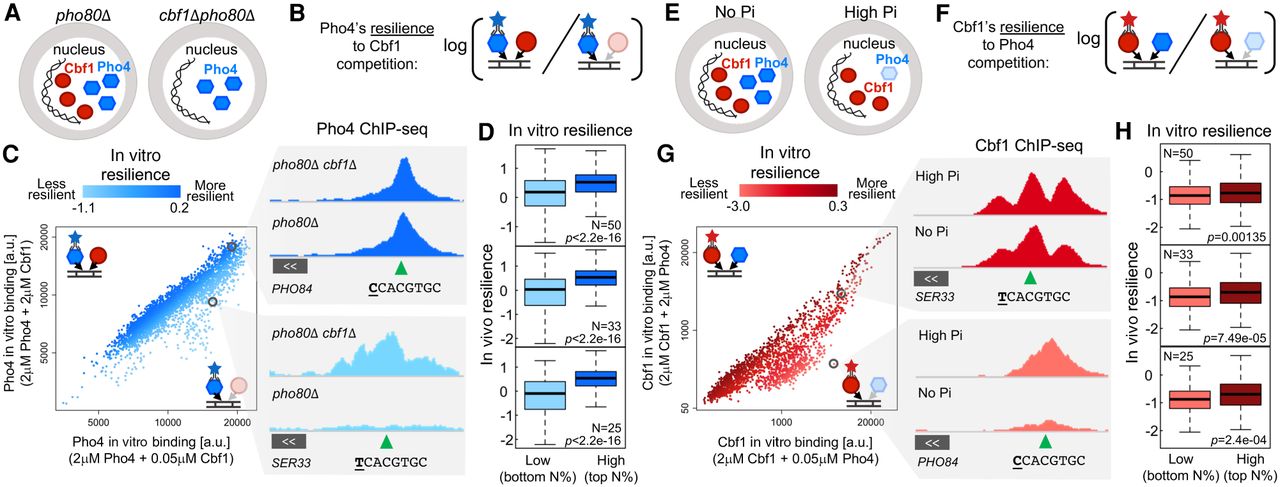
In vivo ChIP-seq data reflect the in vitro competitive binding patterns of Cbf1 and Pho4. (A) Data from S. cerevisiae strains pho80Δ and cbf1Δpho80Δ (Zhou and O'Shea 2011) were used to assess the effect of Cbf1 competition on Pho4. (B) Definition of the term “resilience” in the context of Pho4-Cbf1 competition. A smaller value of resilience indicates a larger impact from TF competition. (C) Left: Genomic Pho4 binding sites tested in the competition PBM assay, colored by Pho4's resilience to Cbf1 competition. Right: Genome browser tracks showing in vivo binding data at sites with high in vitro resilience (upper panel) versus low in vitro resilience (lower panel). The site with high resilience is less influenced by competition in vivo, whereas at the site with low resilience, Pho4 is efficiently outcompeted by Cbf1. (D) Comparisons between the in vivo resilience scores of genomic sites with low versus high in vitro resilience. Plots show comparisons between the top versus bottom N% of sites, sorted in decreasing order of in vitro resilience, for N = 50 (top), 33 (middle), and 25 (bottom). See Supplemental Figure S5B for a full comparison of resilience scores at individual binding sites. (E) Data from S. cerevisiae EY57 cells grown in media with no inorganic phosphate and high inorganic phosphate (Zhou and O'Shea 2011) were used to assess the effect of Pho4 competition on Cbf1. (F,G,H) Similar to panels B, C, and D but showing the effects of Pho4 competition on Cbf1 binding.