


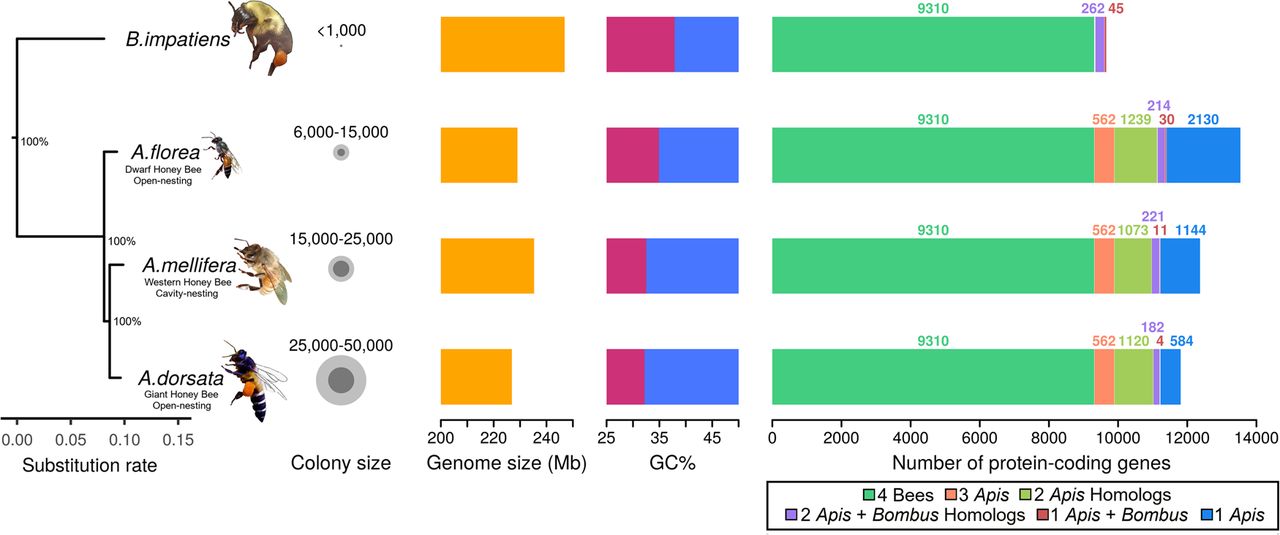
Phylogenetic, genomic, and gene content comparisons of three honey bee species. (Left to right) Maximum likelihood phylogeny built from 9310 concatenated single-copy orthologous proteins from sequenced honeybees and bumblebee outgroup indicated that A. florea diverged first from the most recent common ancestor of honey bees (all nodes 100% bootstrap supported). A. florea represents the dwarf honey bees, and A. mellifera and A. dorsata represent the cavity nesters and the giant honey bees, respectively. Tree visualization was performed using ggtree (Yu 2020). Circles represent colony size ranges with dark gray indicating the lowest and light gray the highest colony size; the yellow bars depict the genome size of each species, and the red/blue bars correspond to the average GC content of the genome of each species. Average genome GC content decreases with increasing colony size. The rightmost horizontal bar plots show total gene counts for each species partitioned according to their orthology profiles. A. florea possessed the greatest number of lineage-specific genes followed by A. mellifera.



