


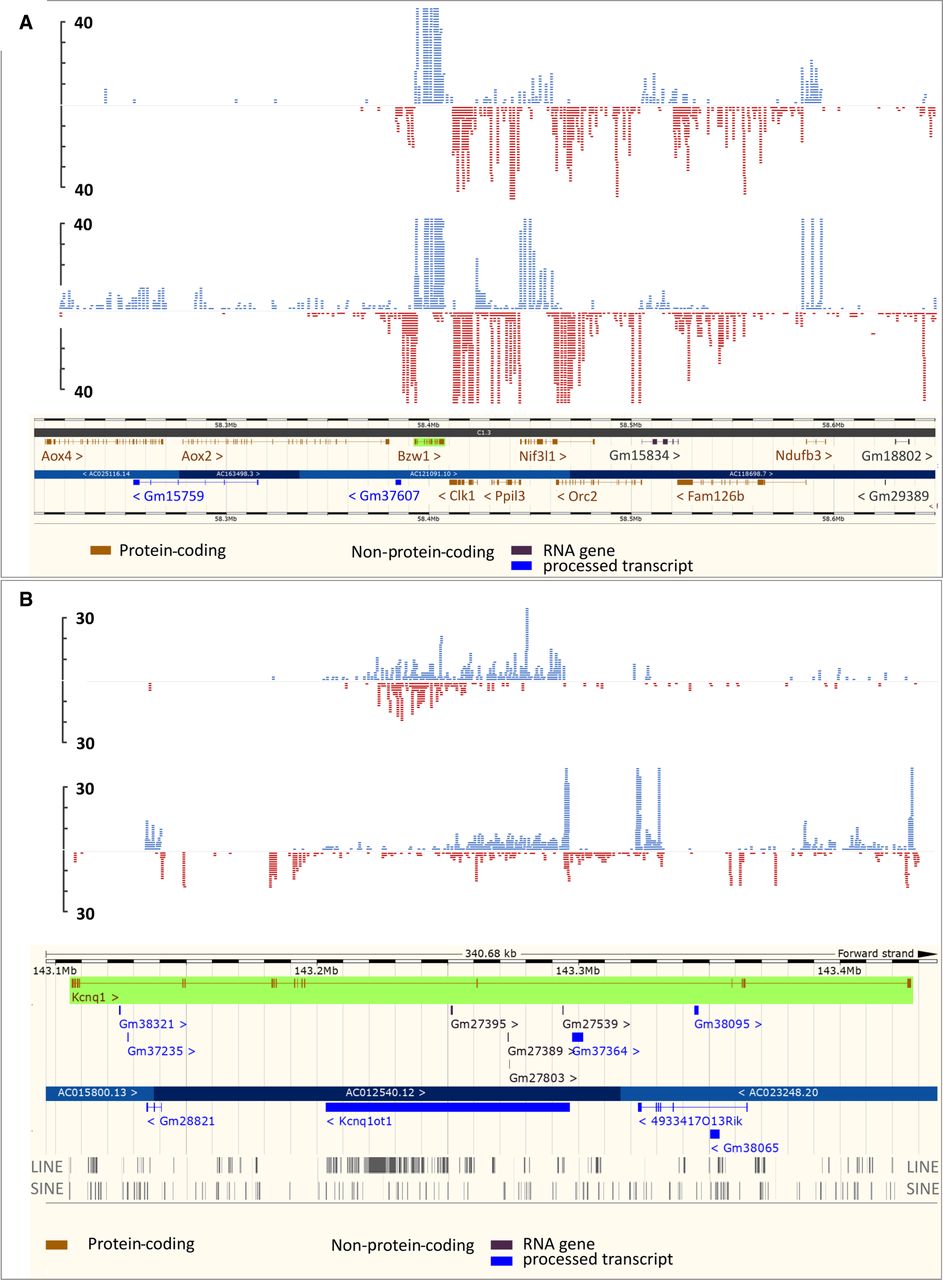
Genome browser snapshots (SeqMonk) of representative examples of dsRNA-associated gene clusters. Two individual data sets with high read coverage from adult murine kidney (R2 and GSM900193) (Pervouchine et al. 2015) are shown. The upper panels represent the dsRNA-enriched sample (R2), the lower panels represent testis RNA (GSM900193). (A) The cluster encompassing the genes Bzw1, Clk1, Ppil3, Nif3l1, Orc2, Gm15834, Fam126b, and Ndufb3 shows reads mapping to both strands in exons of the related genes, although at low levels. There are hardly any regions that contain reads in both orientations. The adjacent cluster, also containing genes with complementary exons is not expressed. (B) Snapshot of the parentally imprinted Kcnq1 gene. The protein-coding sense transcript is not expressed in males; however, the related antisense transcript is expressed, and reads in both orientations are detected. This could be the result of intramolecular dsRNA formation by SINE and LINE elements enriched in this region. The blue bars represent the + and the red bars the – strand.



